

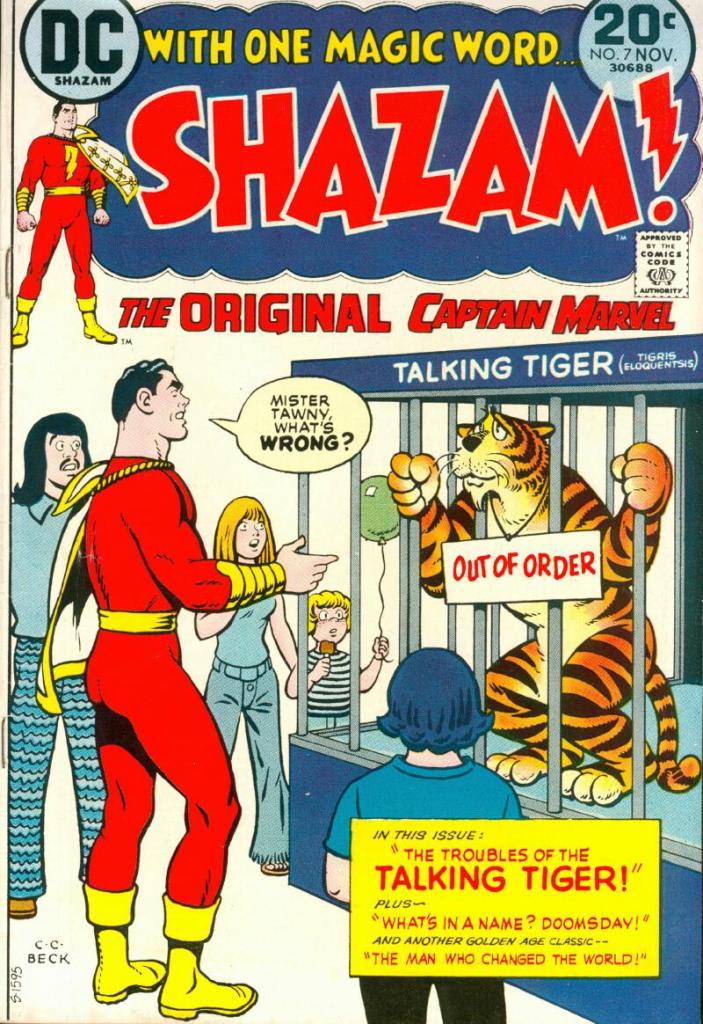
I continued over a period of a day or two to delve into the complete run of SHAZAM that my grade school friend Donald Sims had lent to me. By now I was up to issue #7, an issue that I can vaguely remember having seen on the spinner rack at my local 7-11 some time previously. This issue reintroduced one of the most unlikely members of Captain Marvel’s cast of characters, the anthropomorphic tiger known as Tawky Tawny. His stories had clearly been loved by his originator, Otto Binder, who used the character regularly for the final five years or so of the Captain’s golden age adventures.
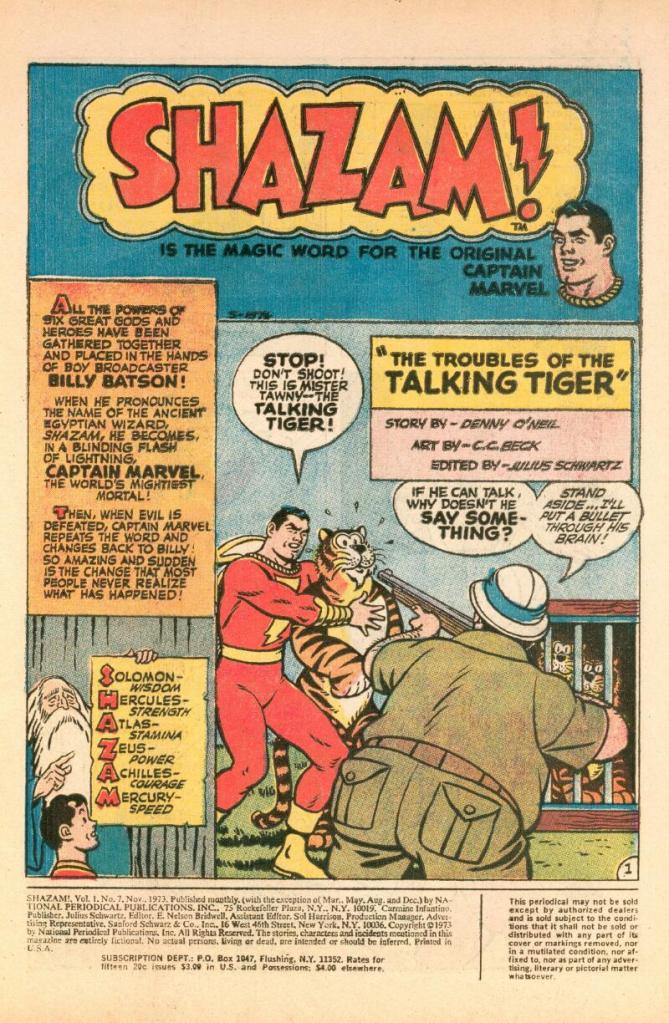
The lead story that brings Mr. Tawny back was again written by Denny O’Neil, who seems uncomfortable on the series and who seldom put his best foot forward on it. Possibly because he himself had some fondness for Tawny, this story was one of his better ones on the feature. But I don’t know that artist C.C. Beck, who was growing more and more vocal about his discontent for the title’s scripts, felt the same way. Still, O’Neil was editor Julie Schwartz’s go-to writer in this time period for key assignments, and so he stayed in place thanks to the importance of launching Captain Marvel’s comeback properly.
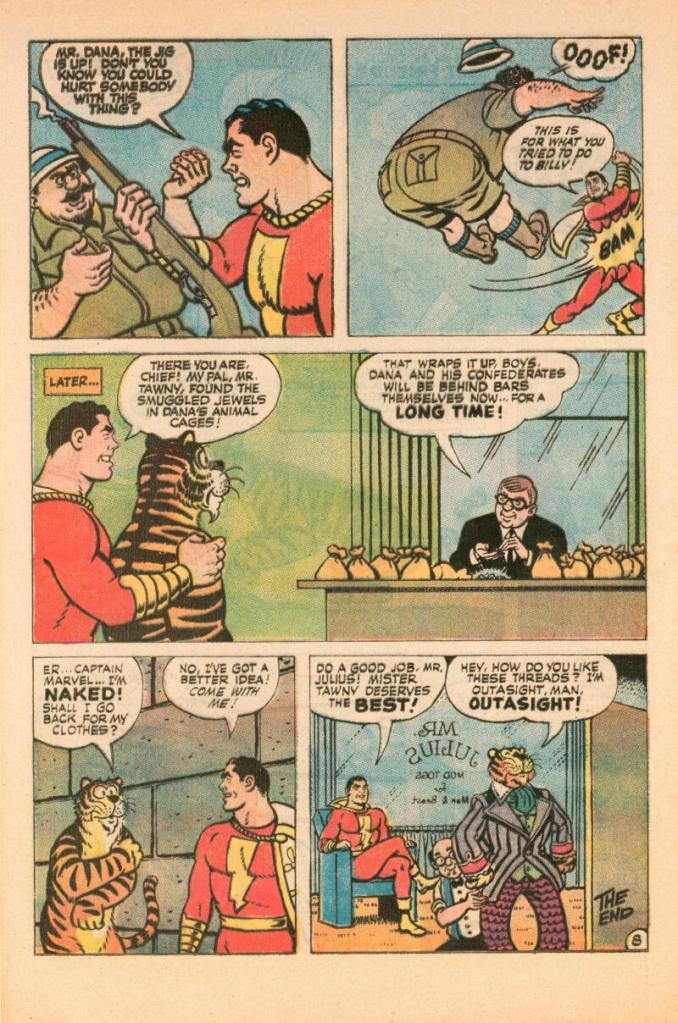
As usual, the new Captain marvel stories were only 7 or 8 pages in length, which left them being pretty flat and lifeless. The series was clearly being produced for a younger audience than DC’s typical super hero fare. In this tale, Mr. Tawny goes undercover in a millionaire’s private zoo in search of some smuggled gems. There’s a really strange and disturbing moment where Billy Batson is captured by the criminals and doused in catnip, which causes Mr. Tawny to go berserk and try to eat him. Yow! In the end, though, everything comes out all right, and Tawnys wardrobe is (unfortunately) updated for the early 1970s by a tailor modeled after the series’ editor Schwartz.
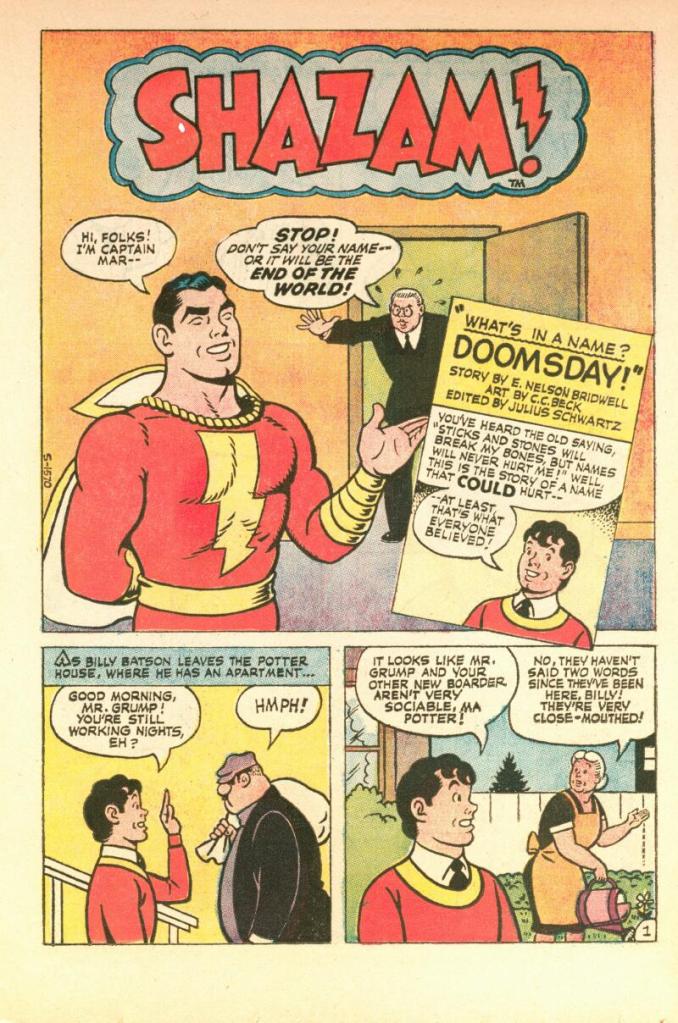
The second story in this issue was written by assistant editor E. Nelson Bridwell, who had been a big fan of Captain Marvel in his younger days. Nelson had a better feel for the kind of material that the series needed that pretty much anybody else at this point, and so his stories tended to ring the closest to the classic Fawcett material. His premise here is very simple: a criminal who is so outraged by the fact that Captain Marvel once put him in prison inadvertently starts a rumor that the very mention of captain marvel’s name will cause catastrophe and ruin. There isn’t anything to this rumor, but the very fact of its spread begins to cause problems for the Captain and Billy.
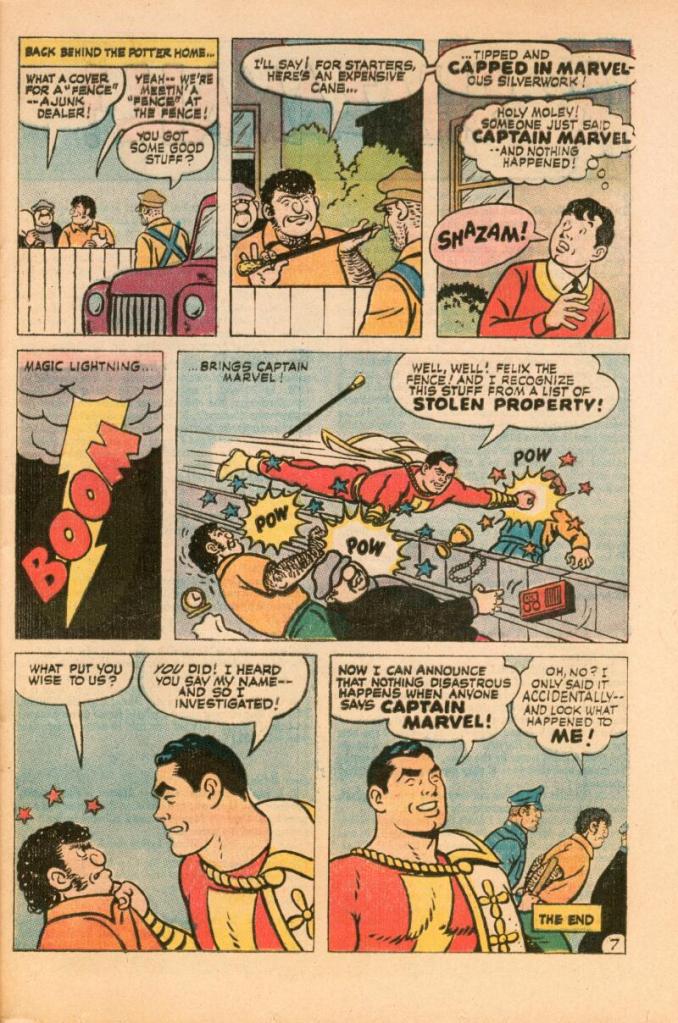
It takes Captain Marvel a while to get to the bottom of things, as even his nemesis Dr. Sivana is afraid to say his name aloud for fear of destroying the world. In the end, though, Cap comes across the criminal who started this entire chain of events as he talks about fencing a stolen cane that is Capped in Marvel-ous silverwork. As this sounds like Captain Marvel and nothing untoward happens, Cap realizes that the whole mess has been a mistake, and promptly captured the bad guys. It isn’t much of a story in 7 pages, but it does have more of a sense of the whimsey of the original Fawcett material.
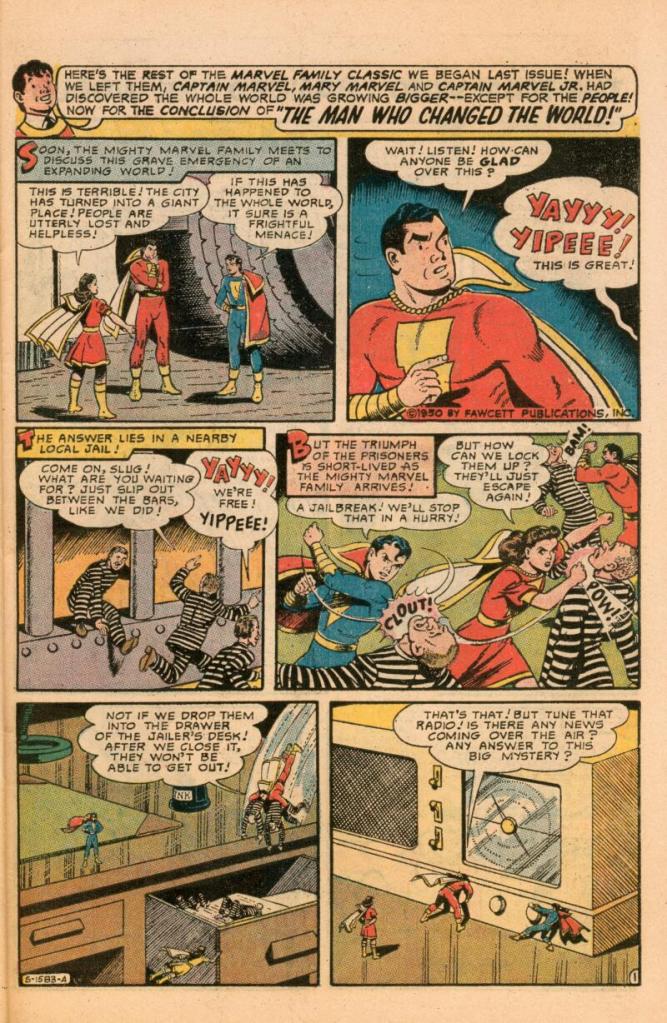
The classic reprint slot in this issue continues with the second half of “The Man Who Changed The World”, which had been started the previous month. No idea why they chose to break this particular story in half, but it’s once again the best thing in this issue despite being only the latter half. Having been shrunken to tiny size by a well-intentioned professor who is trying to find a way to deal with the population explosion, the Marvel Family joins forces to get to the bottom of things and restore everybody to their proper heights. it was written by Otto Binder and illustrated by Kurt Schaffenberger.
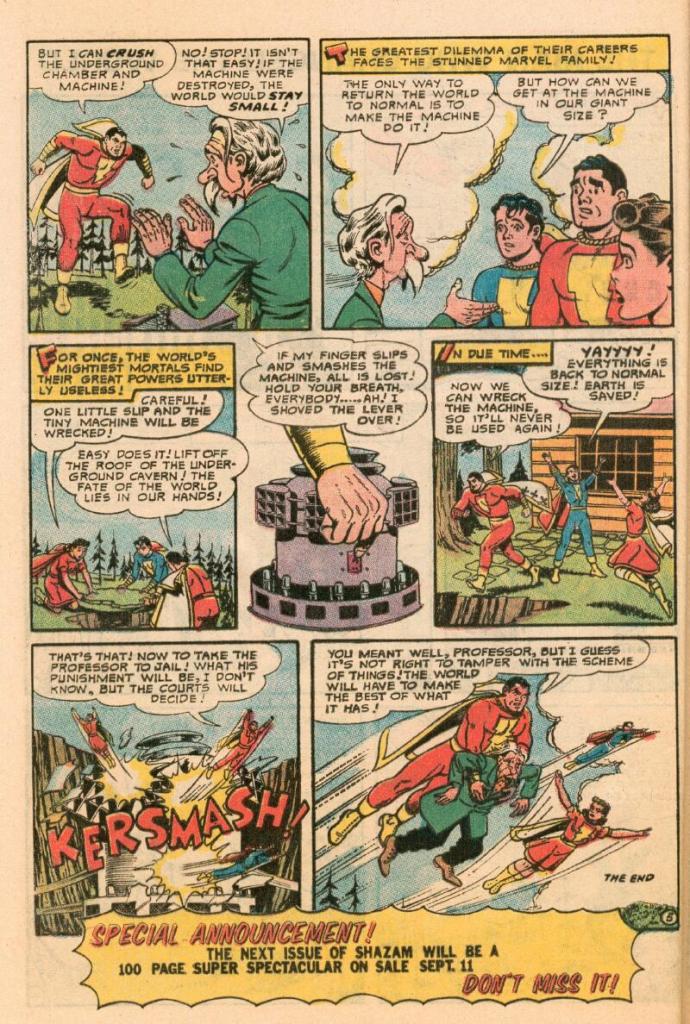
But before all is said and done the Marvels wind up with the opposite problem to wrestle with, as the Professor’s device causes the population to grow to gigantic proportions once it’s reversed. And now, everybody is too large to enter the Professor’s lab and fiddle with the device. So the Marvels have to very carefully extract the device and reset its controls without accidentally destroying it. Which they do, of course, and the day is saved. The final page announced that the next issue of SHAZAM would be in the 100-Page Super-Spectacular format, something that I already knew as I had that next issue right in front of me in the stack. But those 100-Page books were always welcome to me.
 The Tom Brevoort Experience
See this is what I don’t get, if DC thought the original Captain Marvel only appealed to a younger audience then why the hell did DC sue Fawcett over Captain Marvel when their handling of the character suggests that they didn’t think he appealed to Superman readers? Or was the point to sabotage Captain Marvel at DC so he wouldn’t outsell Superman at DC?
LikeLike
You’re talking about two completely different time periods. The lawsuit happened in the 1940s, when Captain Marvel and Superman were absolutely competing for the same audience (and Cap was winning). By the 1970s, the average comic reader was starting to skew a little older (though the books were still generally accessible to kids). The Captain Marvel revival was based on nostalgia — older fans remembered the character fondly, and DC hoped to capitalize on that. Because of the nostalgia factor, they made the decision to try and keep the style as close to those old comics as possible, rather than doing some kind of reboot or update. As Tom points out, that led to mixed results, as younger writers like Denny O’Neil were a bit outside of their usual wheelhouse.
Of course, there’s no guarantee that a “modernized” Captain Marvel would have fared any better — DC was cranking out all kinds of new titles in that era, and very few of them had any lasting success.
LikeLike
I think you are correct. I think it’s also fair to say that DC and Schwartz could have also been possibly adverse to have the then-licensed Captain Marvel be reintroduced with a more modern take that could have diluted Superman’s readership.
As awkward as the 70’s Shazam is… to me he still fits in his own world way better than as a peer of Superman and a member of the Justice League.
Decades later Marvel comics would make a somewhat similarly move that was even odder by retroactively dropping in a Superman/Captain Marvel type into their continuity. The difference being that no one had any nostalgia or affection for the Sentry. The upside is the same as the downside in that no one cares what happens to him.
LikeLike
Mister Tawky Tawny is the best.
LikeLiked by 1 person
Did younger readers actually buy the book? I’m guessing not as they moved away from that approach as the series kept going.
LikeLike