

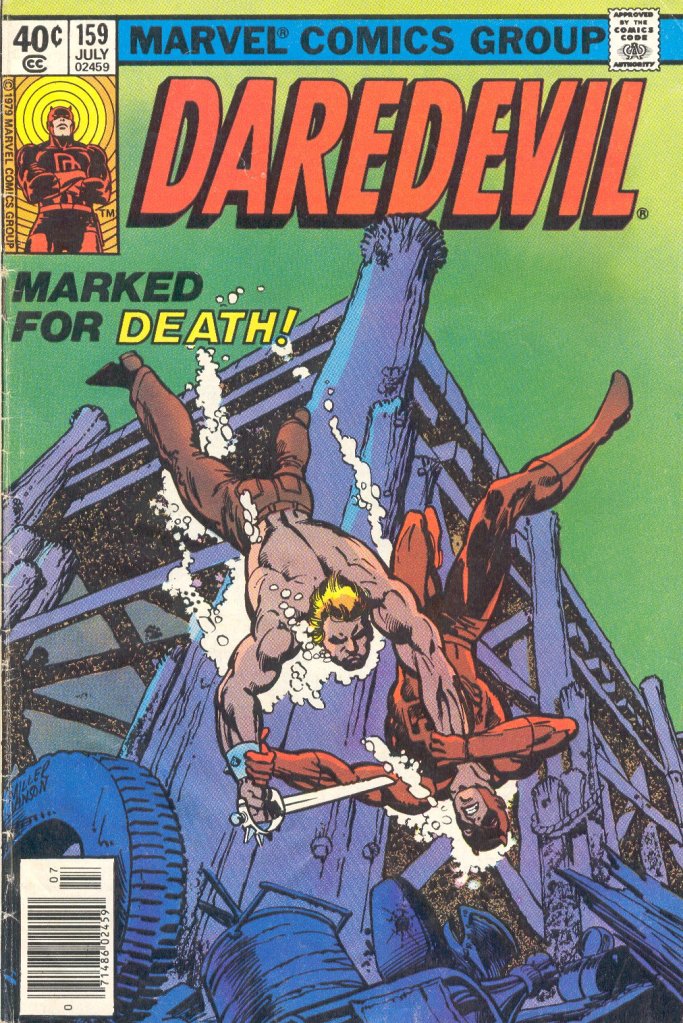
I had no way of knowing it at the time, but we were heading into what is largely considered the best, most significant run on DAREDEVIL of all time. I had been enjoying the series just fine since I first started reading it several months previously, and I didn’t really sense a shift in the narrative. But this is really the issue when the Frank Miller era kicked off. Frank had drawn the previous issue as well, but it was dedicated to wrapping up a variety of earlier plotlines, most of which involved typical Marvel action and villains. This was the first issue to begin to feel a bit more grounded and street level.
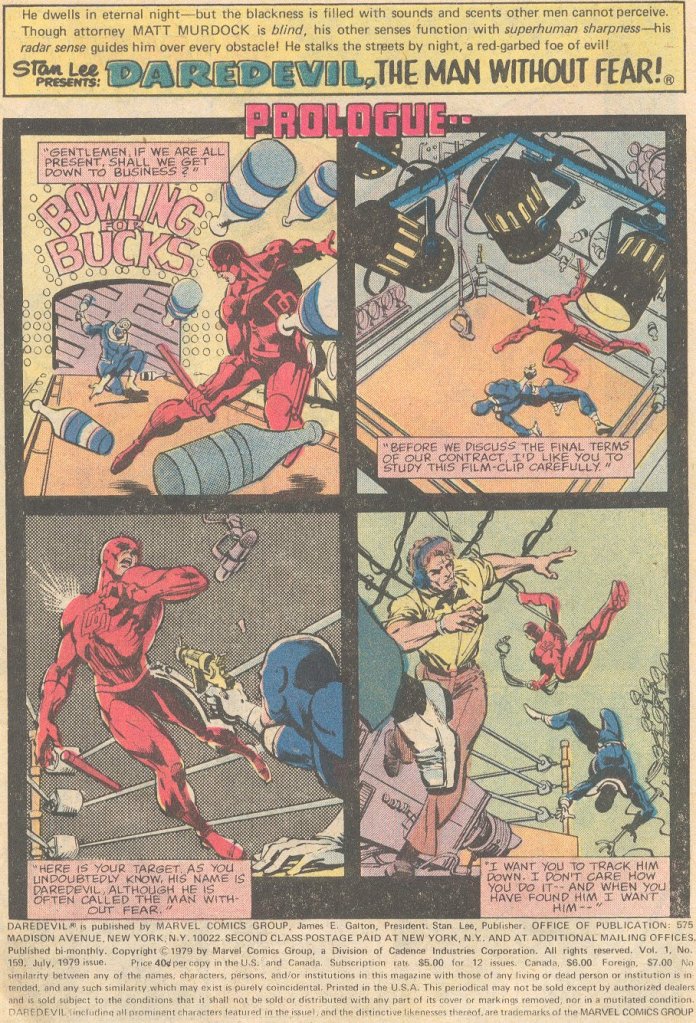
Looking back at it today, it’s not simply the art style that’s changed, but also the color palate. As you’ll see as we work our way through this book, colorist Glynis Wein seems like she was simpatico with what writer Roger McKenzie and artist Miller were going for here, and so she darkens down her traditional palate for something a bit more overtly noir.
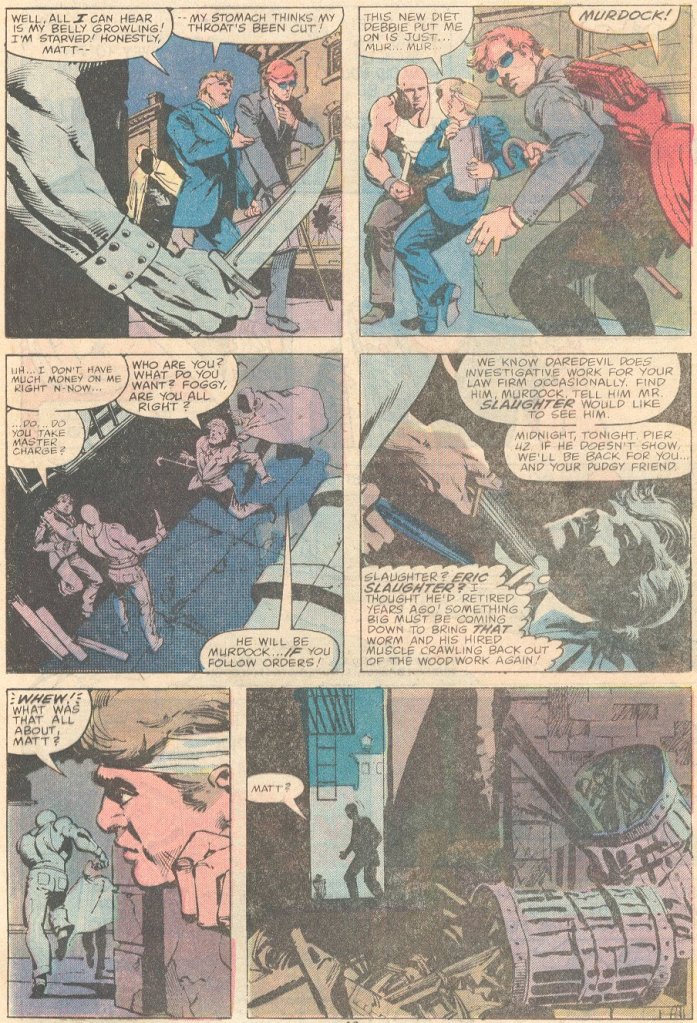
Miller, backed up by seasoned embellisher Klaus Janson, hits the ground running, with a clear idea of what he’s doing. His compositions, both page and panel, are interesting and direct, and he innovates a bit with his page structure, using long vertical and horizontal panels in a way that few had up to this point. He also drapes everything in moody shadow, the better to evoke the notion that, like Batman, Daredevil is a creature of the night character, rather than a primary-colored do-gooder like Spider-Man. Just that adjustment alone made a big difference in how the character was perceived moving ahead.
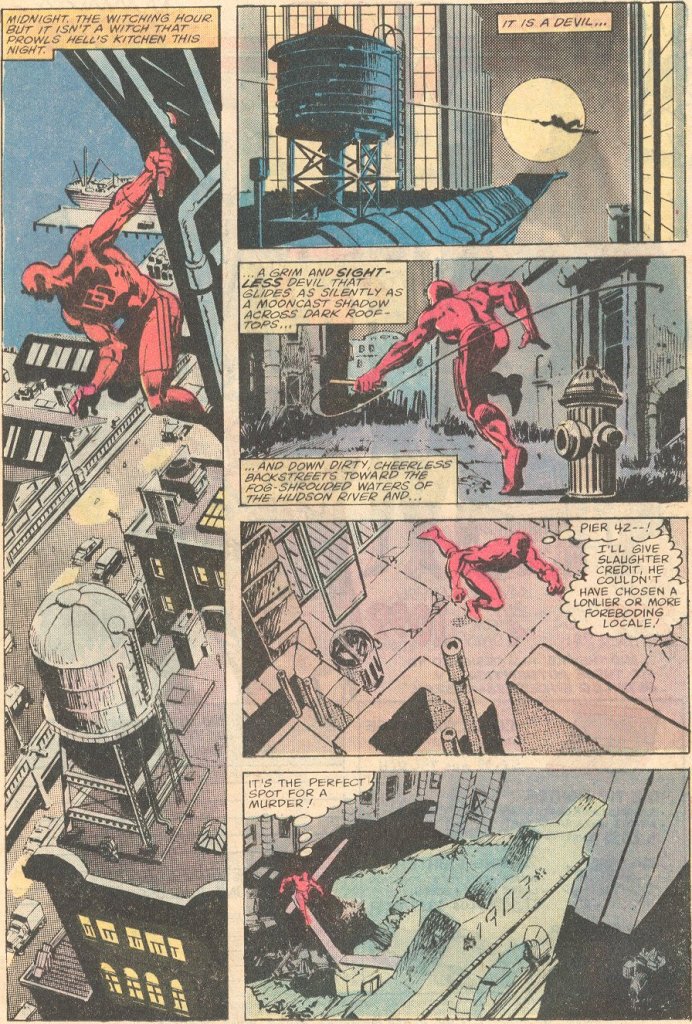
Like pretty much all of Marvel’s output at this time, this issue would have been crafted ‘Marvel style”–which is to say that there was a written plot, then the artist drew the entire book, and the writer thereafter went back and crafted the final copy from the artwork. This tended to make the Marvel books of this period more visually interesting, and even this early on in his career, Miller runs with the ball. There isn’t a whole lot of story to this page, but it does a great deal in characterizing both DD and the city. In particular, the buildings are distinct and interesting, and just a little bit run down and lived in, crumbling around the edges. For his part, McKenzie exercises restraint. Pages like this one were common in AMAZING SPIDER-MAN, and were an opportunity to get into the wall-crawler’s head and let him quip and be funny. But here, much of the action is carried out silently, with a minimum of thoughts or words. it isn’t as extreme as it would get once Miller began dialoguing his own work, but it’s a lot more dialed back than was typical in this era.
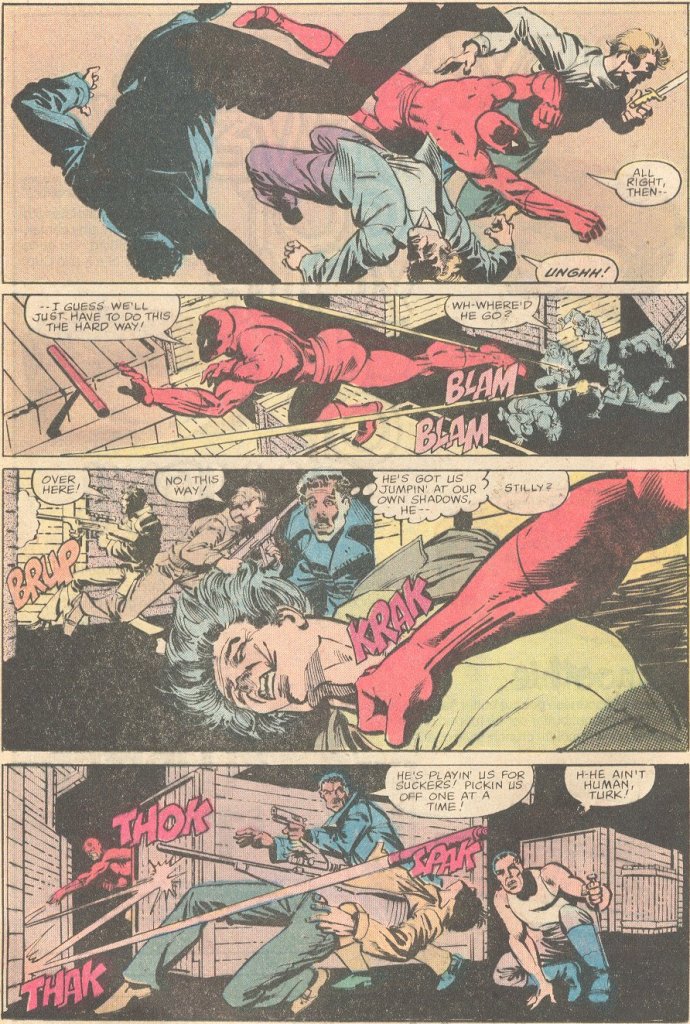
As for the story, it’s relatively basic. The issue opens with the mysterious Mr. Pondexter running footage of Daredevil defeating Bullseye from an earlier issue for the mob of Mr. Slaughter, a retired crime boss. Pondexter wants Slaughter’s gang to put a hit out on Daredevil. to draw the Man Without Fear out, Slaughter sends men to rough up Matt Murdock and Foggy Nelson, who are known to have a connection with the crimson crusader. And sure enough, this brings Daredevil out of the woodwork to the ambush at the docks. Daredevil fights his way through a ship crammed with Slaughter’s killers.
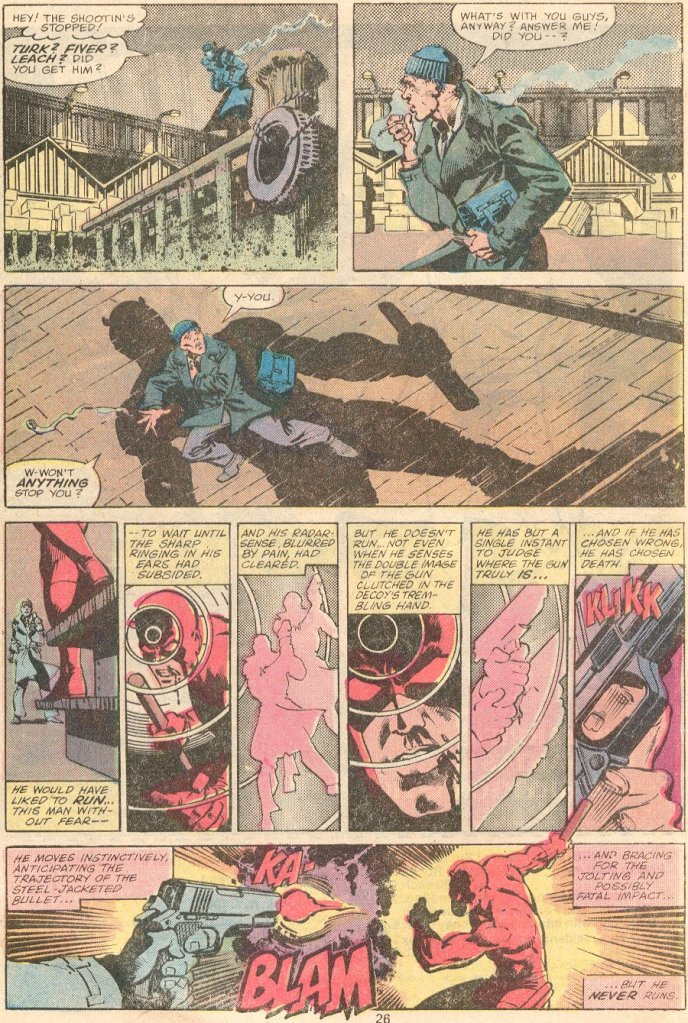
There’s a cool sequence where McKenzie and Miller turn Daredevil’s trump card–the fact that his other senses have become remarkably heightened so as to compensate for his blindness–into a deficit by having a gun discharged directly next to Daredevil’s ear. The sharp noise of the shot rattles Daredevil, causing his radar sense to fritz out a bit as he pursues the last of the killers. Despite his handicap, the sightless sentinel is able to bat a bullet out of the air with his Billy club, thus bringing the confrontation to a close. This moment plays into Daredevil’s nickname as “the Man Without Fear” in a way that had seldom been attempted previously.
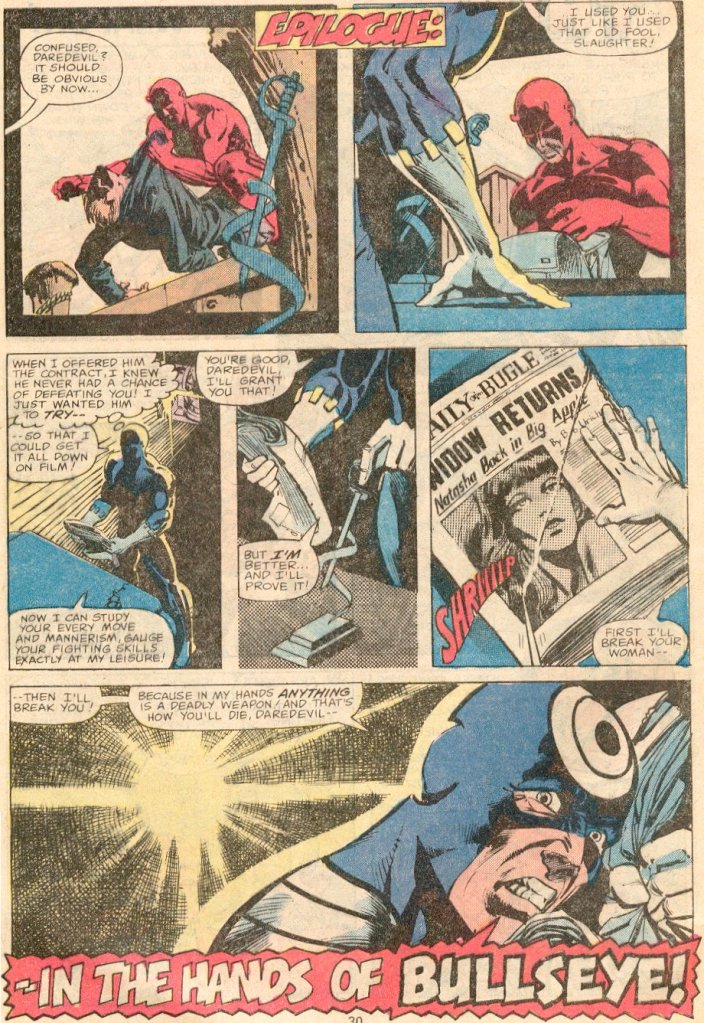
But on the final page of the issue, we learn Mr. Pondexter’s true identity. He only arranged the hit on Daredevil so that he could study his foe’s moves up close–and now Bullseye is ready to get his revenge on the man who humiliated him earlier. This was the beginning of shifting Bullseye into something a bit darker and more plausible than the flamboyant costumed criminal he’d been in earlier stories.
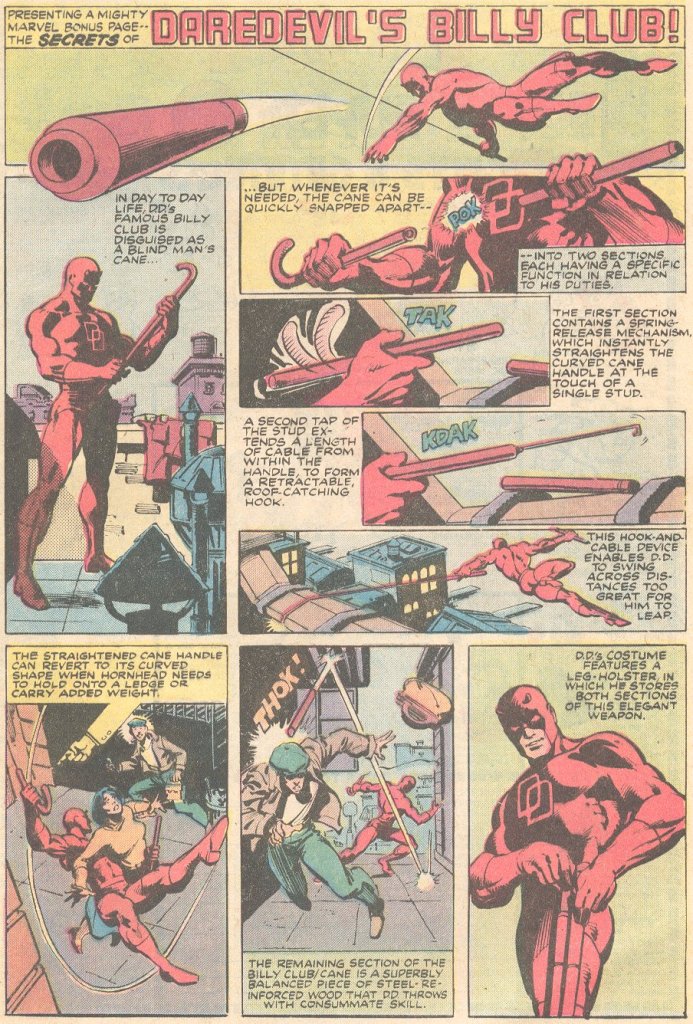
Rather than a letters page, this issue instead includes an extra page of story and art, a featurette clarifying the specifics of Daredevil’s trusty weapon, his Billy club. Which, it turns out, is actually two separate clubs, each one with its own specific purpose and function. For all that, it’s seldom that we’ve ever seen Daredevil use both pieces at once, which you’d think would be an obvious thing to have him do at some point.
 The Tom Brevoort Experience
The panel with DD swinging round the rooftop water tank is superb!
LikeLiked by 1 person
Jansen fit early Miller perfectly. I think only Bob Wiacek was a better fit, since my memory of Karma’s debut in that MTU Annual lives on as best Miller drawn story I’ve ever read.
LikeLike
“He also drapes everything in moody shadow, the better to evoke the notion that, like Batman, Daredevil is a creature of the night character, rather than a primary-colored do-gooder like Spider-Man. Just that adjustment alone made a big difference in how the character was perceived moving ahead.”
Given that McKenzie had DD do one of those “Batman vanishes while Commissioner Gordon’s back is turned” scenes, I very much got the impression that he was deliberately emulating Batman (and the Denny O’Neil version more than others), and that suited Frank’s approach just fine.
“Like pretty much all of Marvel’s output at this time, this issue would have been crafted ‘Marvel style”–which is to say that there was a written plot, then the artist drew the entire book, and the writer thereafter went back and crafted the final copy from the artwork.”
There were occasional books plotted via a phone call, but I don’t think any of the McKenzie/Miller DD was.
LikeLiked by 1 person
Hi, Kurt. I didn’t see a credit box on these pages. Who was the editor on DD back then? Too early to have Denny? Could it have been Len Wein? Not that his then-wife couldn’t have colored the book either way.
LikeLike
It was edited by Al Milgrom & Jo Duffy. Though Jim Shooter has said he was the one to assign Frank to the book.
Len was over at DC by then, and hadn’t been EIC since 1975, so while he was editing books before he left it was only books he was writing.
LikeLiked by 1 person
Thanks, @Kurt
LikeLike
Plus Bullseye is similar to Batman foe Deadshot [ Batman#59 ( June-July 1950 ) The Man Who Replaced Batman — A new crime-fighter Deadshot ( comics.org ), posing as a crime-fighter and meant to be a one-off villain ( wikipedia.org ) ]. Bullseye [ Daredevil#131 ( March 1976 ) ] might have inspired Deadshot’s return as an assassin-for-hire [ Detective Comics#474 ( December 1977 ) ].
LikeLike
Well, Bullseye was created by Marv and (I think) Bob Brown; Marv might have been thinking of Batman villains but likely not a forgettable one-off villain from 1950.
And I know Steve Englehart brought Deadshot back because he’d read through a big mess of early Batman stories, and liked the name. That’s also where he’d gotten the idea to bring Hugo Strange back — and he liked that it was a way to write a “Dr. Strange” at DC. And where he got the Joker Venom, though he’d already borrowed that at Marvel for the Red Skull’s Dust of Death.
LikeLiked by 1 person
As Kurt Busiek says, Deadshot was a bar-trivia answer at best before Englehart and Rogers reworked him.
LikeLiked by 1 person
@Kurt Busiek, “Dust of Death”, i.e. super bad egads pee-ew-listics extra halitosis.
LikeLike
@frasersherman, true. But I wonder if it was John Ostrander’s good use of Deadshot in his ’87 (& beyond) “Suicide Squad” that made him even more popular than his Bat-book appearances.
LikeLike
”I wonder if it was John Ostrander’s good use of Deadshot in his ’87 (& beyond) “Suicide Squad” that made him even more popular than his Bat-book appearances.”
Didn’t hurt, I’m sure. But I’m inclined to give a lot of the credit to Marshall Rogers, for that sensational costume design that made creators and readers _want_ to see him again.
LikeLiked by 1 person
Would Ostrander have gotten the artist back then to create a cool enough visual to make Deadshot pop though? If he’d even read the original story, a guy in a tuxedo with guns would have been killed immediately.
LikeLike
TIMELY & MARVEL ( Old Men as head of crime organizations ): The Old One ( crime plotter par excellence ) & Poison, Incorporated ( group of criminals hired out to murder people ) [ Mystic Comics#9 ( May 1942 ) Terror story — John Bradley( construction company owner hired them to kill Star newspaper editor Corky ), Mugsy Murdock ( a racketeer & next victim ) & Eric Slaughter and his gang in this issue. The coincidence of 2 stories separated by decades have a character named Murdock in them.
LikeLike
“The coincidence of 2 stories separated by decades have a character named Murdock in them.”
Not that much of a coincidence, since there are over 35 stories Marvel published before 1964 with characters named Murdock in them, and of course from 1964 on there’s been a steady stream of them.
Irish-Americans used to be pretty thick on the ground in New York City, particularly in lower-class and criminal circles, since Irish-American organized crime dominated in New York’s underworld for over a century, starting in the 1800s. And Murdock’s a pretty common Irish name. So when a Marvel writer was casting around for a name for a tough guy (or a washed-up pug, like Battlin’ Jack Murdock), it’s an easy name to choose.
LikeLike
The three-part story this issue kicked off is excellent. But I think it was more of a harbinger of the Frank Miller Daredevil as we think of it than the beginning. The series lost the mojo it had from this three-parter over the next year, and didn’t get it back until Miller took over the scripting.
In the wake of Jim Shooter’s passing, I’ve reevaluated his tenure somewhat. The Miller Daredevil runs with Klaus Janson and David Mazzucchelli, along with the John Byrne-Chris Claremont X-Men, stand with the Kirby-Lee Fantastic Four and the Ditko-Lee Spider-Man as the four most important bodies of work in the Marvel library. (Shooter is Marvel’s most important editorial staffer after Stan Lee.)
This three-parter stands with the key Miller runs.
LikeLike
Bullseye hires Eric Slaughter’s men in order to study Daredevil’s fighting style and in Buffy the Vampire Slayer season 2 episode 6 ( “Halloween” – October 27, 1997 ) Spike sacrifices some hench-vampires in order to study Buffy’s fighting style while another one records the fight. In Peter Parker the Spectacular Spider-Man#58 ( September 1981 ) a mystery villain overpowers Nighthawk foe the Ringer [ The Defenders#51 ( September 1977 ) ] and puts a device around his waist he says is a bomb in order him coerce him into attacking Spider-Man. It turns out the so-called bomb was meant to study Spider-Man’s fighting style and feed the information into the Beetle’s new insect looking armour.
LikeLiked by 1 person
While for some reason I happened to pick up that very first Miller issue of Daredevil (the end of Deathstalker) I had never been a fan of the character, and stayed pretty much ignorant of Miller’s run while it was going on. (I was a little too young to be plugged into any sort of fan buzz.) So it’ll be interesting to follow it here, if you do further posts.
Incidentally, “palate” is the roof of the mouth and is often used as a metonym for the sense of taste (and in turn for gourmet eating). The board on which an oil artist puts different colors is a “palette”.
LikeLiked by 1 person
THE MAN WITHOUT FEAR: What If?/Elseworlds just before Matt Murdock thought about creating his Daredevil identity, Green Lantern Abin Sur’s green energy brought him to Abin and Matt became Green Lantern instead.
LikeLike