

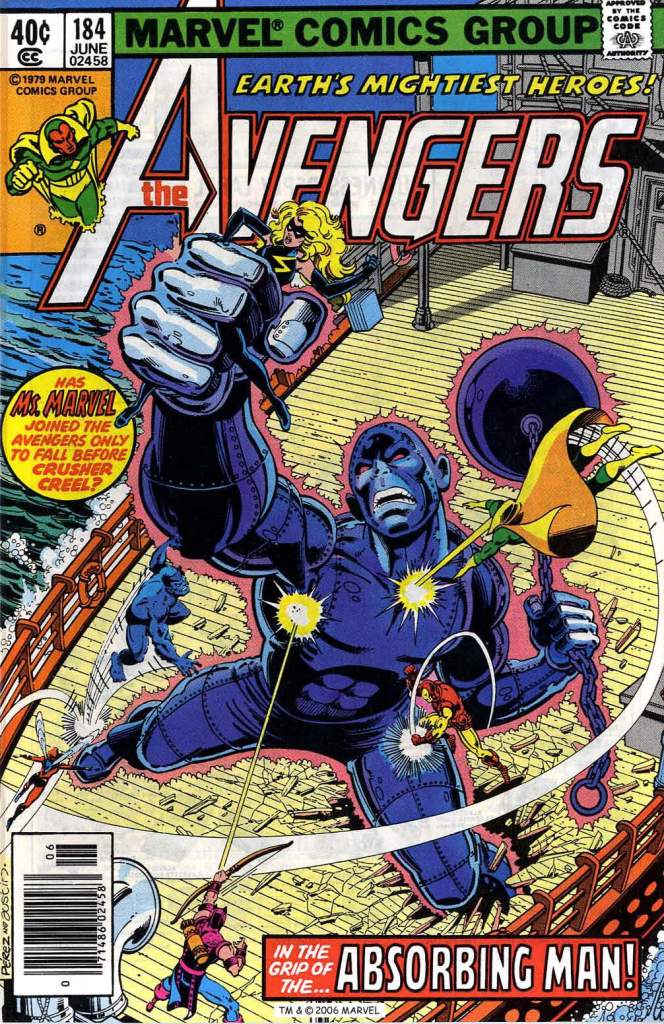
For all that the title was still clearly struggling to get itself out of the scheduling hole that it had been trapped in for the past year or so, AVENGERS remained a consistently enjoyable read. I think a strong part of that came down to the book’s artists: George Perez, who had left the series but who continued to do covers and retained through them a personal stamp on its style, and John Byrne, who while he’d go on to even greater popularity was this early on already a creator to watch. Byrne’s speed and work ethic combined with his strong plotting skills meant that he could typically be found in the pages of two or three titles every month, and his work was always welcome. Like the first half of this two-parter, this issue appears to have been an emergency rush-job; one inked by enough different people all at once that it carries the credit Diverse Hands. But even so, it still reads well.

Writer David Michelinie had taken over scribing the system in mid-stride from now-Editor in Chief Jim Shooter, and so closely followed in the wake of the approach that Shooter had set out that it’s difficult for me after all these years to discern where Jim leaves off and David comes in. By this issue, though, Shooter wasn’t contributing to the plots and Michelinie wasn’t wrapping up story threads begun by his predecessor. So this story is all his (well, his and Byrne’s, since John was working Marvel-style which meant that he had a powerful influence on the plot in its visual execution.) Michelinie had a definite voice for AVENGERS that fit the series well–he was, it seems, as concerned with the procedural aspects of such an organization as he was the specific characters who served as members of the team. While he inherited the situation whereby the Avengers are at odds with their government liaison from Shooter, Micheline steered into this conflict and expanded upon it, creating tension between the ethos of the team and the conditions under which it was suffered to operate.
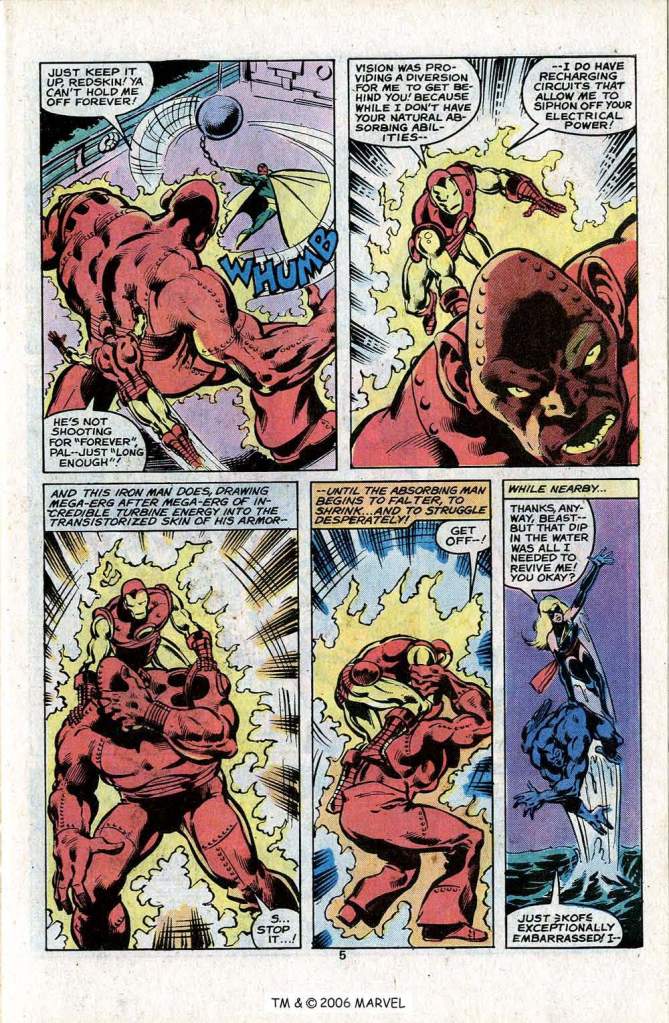
This issue sees Earth’s Mightiest Heroes in battle with Thor’s old enemy the Absorbing Man, who is trying to make his way out of the country in order to avoid the super heroes who have consistently bedeviled and imprisoned him. Now, you would think that a full complement of Avengers would be more than a match for Crusher Creel on his lonesome, but here you’d be in error. Creel makes good use of his magic-spawned ability to absorb the properties of whatever substance he comes into contact with to hold off an entire group of Avengers, who have been brought to the scene by the villain’s earlier rampage. At the end of last month, Creel had taken on the properties of an electric dynamo, and it’s in this electricity-charged state that the Avengers tackle him as the fight continues.
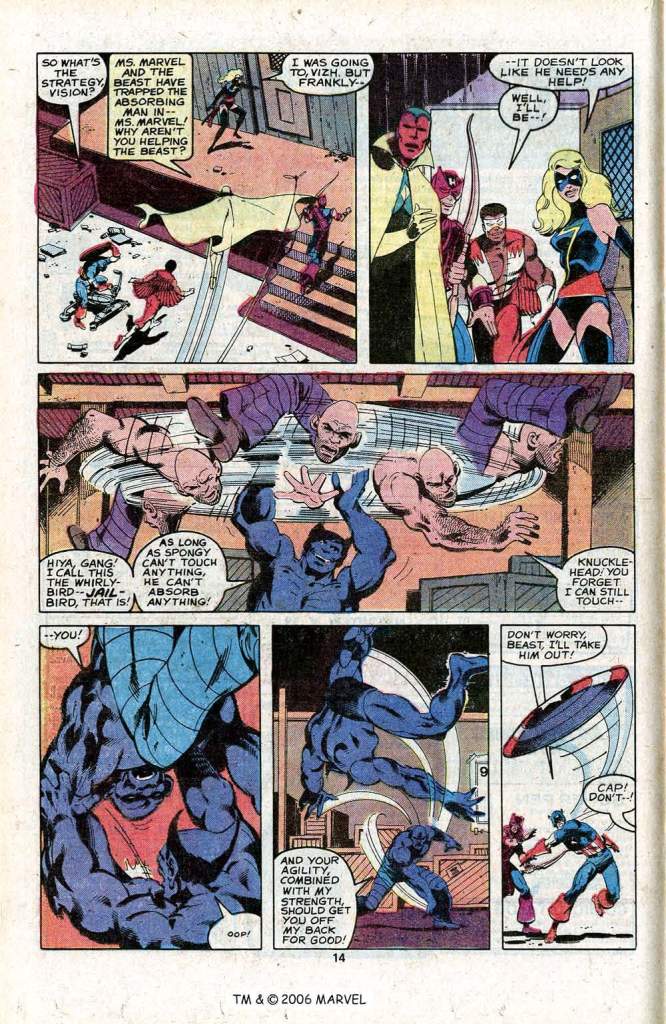
In the meantime, in response to the demands of the team’s new government liaison Henry Peter Gyrich, Captain America has persuaded his partner the Falcon to sign on as an Avengers in order to meet affirmative action minimums and prevent the group from losing their security clearance. Michelinie goes a little bit heavy on this point here, having Sam Wilson speak in a faux Stepin Fetchit accent as he returns with Cap to sign Gyrich’s paperwork. But the pair is called to the site of the action before they can finish this task. By the time they arrive, the fight has moved away from the boat it had been on and into a nearby watering hole, where the Beast has gotten the momentary upper hand on their quarry. But this respite only lands for a moment or two until the Absorbing Man takes on the properties of the furry mutant and liberates himself once again.
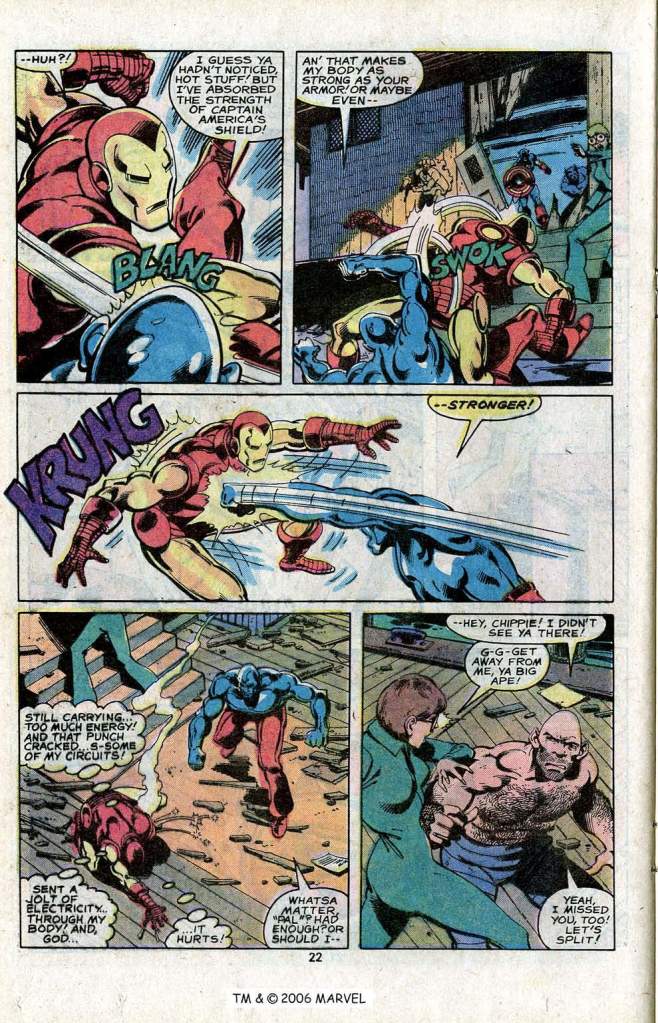
It’s at around this point that the story re-introduces Sandy Herkowitz, a boutique owner who had been kidnapped by the Absorbing Man for companionship on his voyage to South America last issue. In the confusion of the melee, she exits the ship that she and Creel had been on and attempts to get the attention and assistance of the Avengers. But this just puts her back in the firing line once again once Creel notices her. The Absorbing Man is still sticking to his plan to sail off to far-away countries beyond the reach of super heroes, so he grabs up Sandy once more and heads for the docks.
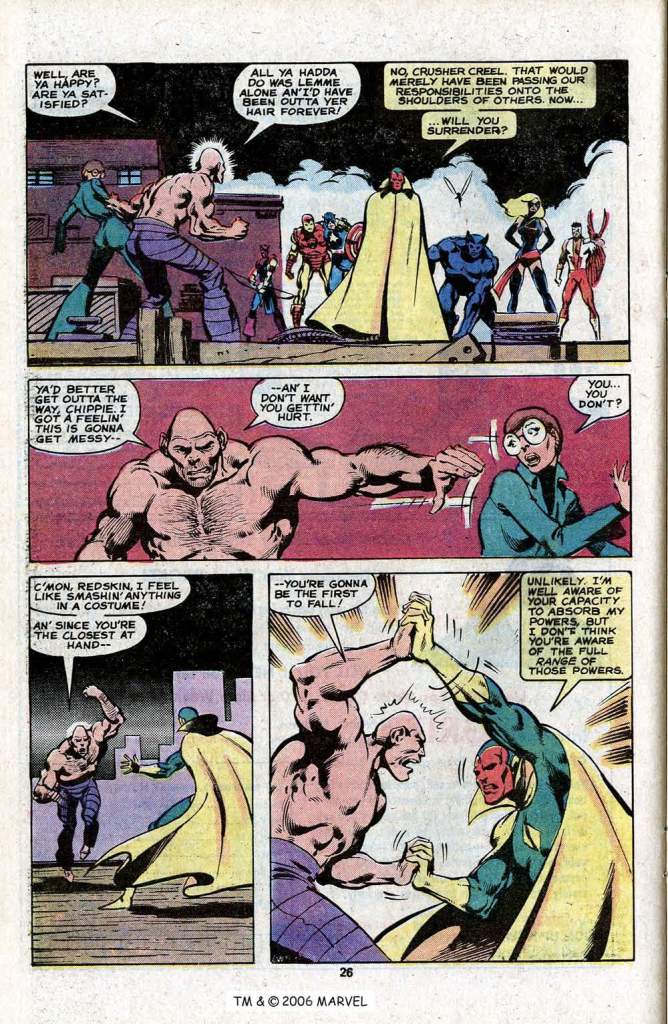
But by the time that Creel is able to convey himself and Sandy back to the dock, the boat they were going to be traveling on has already embarked. Pissed that his simple plan has been so foiled, Creel pushes Sandy to the side, intent on dishing out some revenge on the Avengers whose pursuit has cost him his dream. He first grapples with the Vision, duplicating the android’s density-manipulation powers. But the Vision turns the tables by becoming intangible–and when Creel does the same, his body falls through the pier on which the pair were battling, dunking him into the water.

Creel’s had enough at this point, and he starts to swim out after the departed ship. But the Avengers are right behind him, and he realizes that he’s not going to make it. So as his final move, he absorbs the properties of the water he’s surrounded by and dissipates into the ocean, seemingly demised. It’s pretty clear to any regular comic book reader that the Absorbing Man will be back, but this brings the conflict to a conclusion–save for one somewhat mis-timed final beat. Because Sandy opines that even though she thought Creel was a creep, he still pushed her to safety when he threw down with the Avengers. So maybe he wasn’t such a bad guy after all. Had Creel made good on his plans and carried Stacy off with him to south America, I expect her opinion of him wouldn’t be so charitable, so this moment feels a bit naive and unearned somehow.
 The Tom Brevoort Experience
Tom B writes: “Had Creel made good on his plans and carried Stacy off with him to south America, I expect her opinion of him wouldn’t be so charitable, so this moment feels a bit naive and unearned somehow.”
It sure does… not only were the plans he had for Sandy very unsavory he also planned to take over a chunk of South America.
Even at the time I thought that the Falcon/Gyrich situation was an awkward plot thread… the reader is clearly not supposed to be on the side of government interference, but the optics aren’t great when the “interference” we’re supposed to be against is equal opportunity. It was the Reagan years so maybe Michelinie is attempting to relate the general zeitgeist and not his personal politics.
Other than those points this was a good read though… Cap’s tactical blunder aside.
Is the Beast doing some kind of bit and pretending he can’t lift Creel’s ball and chain or is it supposed to be that heavy?
LikeLike
“It was the Reagan years so maybe Michelinie is attempting to relate the general zeitgeist and not his personal politics.”
Are you referring to Ronald Reagan’s 2 terms as PotUS? 1981 to 1989.
The small print at the bottom of the first page lists this as a “June 1979” issue. Reagan was elected PotUS in Nov, 1980, and was sworn in the following January, 1981.
Not that the “zeitgeist” couldn’t still involve political elements in this comicbook; Watergate was in 1972, Nixon resigned in 1974.
I just think it’s important to state historical facts accurately. 😉
LikeLike
You’re right. My presidential timing is off on this one in regards to who was in the White House as of June 1979… but the country was still definitely tilting right in hindsight.
LikeLike
It was about to (tilt right), but hadn’t yet. No secret there was real dissatisfaction with economic developments during President Carter’s 4 years. Some out of his control. OPEC engineered gasoline shortages and price spikes. Jimmy was too honest and principled when it wasn’t convenient. He could’ve stretched presidential power as other presidents had, and have since, to mitigate some conditions. But he wanted to stay strictly within his limits as provided by the Constitution. And the US was still wracked by the horrors and recent defeat in Vietnam. Not to mention the shock of assassinations in the 1960’s were still painful. Carter’s admin, despite reaching some key milestones in international affairs (Israel & Egypt signing the Camp David Accord), and in environmental protection legislation, couldn’t get the nation out of it’s collective slump. Which worsened with the hostage crisis in Iran. And then again, the highly principled Carter boycotting the Olympic Games in Moscow in response to the USSR’s invasion of Afghanistan.
Reagan would return some confidence, superficially, by stroking the national ego. Never mind his increasing the national debt, the crisis on Wall St. which would foreshadow more corporate greed in the coming decades. The clandestine and illegal military operations in Latin America. Reagan inflated our self image with a lot o hot air and bullshit. He took credit for the hostages returning from Iran, despite that it was Carter’s negotiations that brought them back. And Reagan benefitted from great timing, as the USSR collapsed while he was president. It’s possible it would have regardless of who was in the White House, due to so many other factors.
We tilted right because too many people were disillusioned with the status quo, and the Democrats were too subtle, nuanced, and slow to resolve it. The Republicans knew exactly what to tell the American people, even if it wasn’t very truthful. And despite the fact that it was Republican and conservative policies that were often responsible for getting us the mess we were in in the first place. That would become even more true in the last 40 years. But Repubs always know how to persuade voters into giving them another chance, even if they have to lie about themselves not having caused the problems.
LikeLike
The Falcon/Gyrich situation is a bit awkward, but it’s before the Reagan years. It is, however, part of the zeitgeist then… and still today as people largely misunderstand the program and the idea behind it. Gyrich’s “quota” isn’t part of affirmative action at all – quotas are actually illegal (and always have been) under the enabling legislation. Recruiting a black man to fill some government stiff’s idea of a quota would have been highly patronizing – something Falcon’s portrayal clearly indicates. But by portraying the issue as one of quotas or affirmative action minimums, it buys into the idea of “reverse discrimination” and allows white men to take on the mantle of being the victim of government overreach.
LikeLiked by 3 people
I know Falcon’s strong friendship with Cap (Steve) made it seem like a good idea to bring him, specifically, into the Avengers, as opposed to Marvel creating a new character, or choosing from one of the very, very few other Black superheroes that existed then. Brother Voodoo might have seemed too extreme for some readers, & even maybe to the fictional population of the Marvel Universe’s Earth.
I gotta wonder, though, I think Power Man (Luke Cage) could’ve been a better fit, big picture. And maybe he’d have stuck around a lot longer. Yes, Gyrich might’ve rejected it. But the Avengers’ writers and editors could’ve justified it if they wanted to. Some other gov’t official who ranked higher than Gyrich, or something. Maybe Cage was still too “fringe” for Marvel editorial compared to Sam, despite stints in the Defenders and Fantastic Four.
But from a team operational standpoint, I think he had more to offer the group than Sam, just in terms of raw power. Yes, back then Luke wasn’t as strong as he is now. But again, that could have been written in pretty easily. Some of those fights during that time would’ve gone differently. Cap, Tony, Carol, Wanda, Vision, Beast, and Luke Cage? That would’ve been very cool. Visually, story-wise, and character interaction.
LikeLike
Tim:
“I gotta wonder, though, I think Power Man (Luke Cage) could’ve been a better fit, big picture.”
He had his own book at the time, with Iron Fist. And while it wasn’t selling as well as AVENGERS, I doubt Marvel would have wanted to break it up or complicate it by giving Luke a part time gig with an income.
LikeLike
Am I remembering correctly that Byrne was drawing Avengers, Fantastic Four, and X-Men simultaneously? That’s crazy!
LikeLike
There were 17 story pages an issue at that time, so that works out to 51 pages a month. Byrne’s typical speed for pencils throughout his career was about 2½ pages a day. He’s always seemed pretty comfortable with it. Kirby, the Buscemas, and Gil Kane were even faster.
LikeLike
I think he was doing as much as he could, because it was such a treat to get all this opportunity (and because, until royalties started kicking in, the only way to do better in comics was to draw more). But he had a heart attack somewhere around this time, and I think he learned to stop pushing quite so hard.
LikeLiked by 1 person
John Byrne had a heart attack circa 1979-1980? Or ever? This is the first I’ve heard of this happening. A search of his website’s message board shows no mention of it. A Google search also turned up nothing.
Byrne turned 30 in 1980, and that’s a hell of a thing to have happen to someone that young. Particularly given that Byrne reportedly never smoked cigarettes or did recreational drugs, and rarely drank. While he looks a bit paunchy in photos of that vintage, he certainly wasn’t obese.
Are you sure about this?
Byrne slowed down a little bit during 1980, but he was still drawing over 40 pages a month. But that could very well have been because more assignments weren’t available. He also didn’t live in the NYC area, which would have gotten in the way of fill-in work. He says he stopped doing Avengers because he stopped getting plots for it. (I assume that was due to confusion during the editorial changeover from Roger Stern to Jim Salicrup.) In 1981, he was down to one book a month with Fantastic Four, but Marvel was back up to 22 story pages an issue then, and he was scripting and inking the book as well. That would have certainly cut into his time.
LikeLike
“John Byrne had a heart attack circa 1979-1980?”
Might have been a few years later. In ’79 I was still in Syracuse, and I think I was in New York when I heard about it, but maybe not. But yeah, it was surprising, because he was very young for that sort of thing. It obviously wasn’t a major heart attack, but I do remember people talking about him needing to slow down a little.
I don’t remember anyone talking about it like it was a secret, and I thought I’d seen him talk about it in the press somewhere (though this was the days of THE COMIC READER, so “press” wasn’t what it is today.).
LikeLiked by 1 person
Which was great for those of us that loved his work.
LikeLike
The cliche of “He can’t have been all bad, because was concerned about the safety of the hostage” really should be derided as bad writing just on its lack of merits. A dead hostage is worse than useless. It means all of no more hostage, a murder rap, and authorities who will be much more motivated to inflict let us say extra-judicial applications of force. A seriously injured hostage is a big problem since they may become a dead hostage. Any non-psychotic criminal with some survival sense (and Creel is a just a thug, not insane) knows it’s a bad idea to hurt hostages. Plus, if Creel did win, he’d want his “companion” if possible. Shoving her out of the way as he goes to throw down is not having redeeming qualities, just common sense on his part.
LikeLiked by 1 person
I don’t know much about the innocent bystander and how informed, educated, or biased her “analysis” of Creel is, outside of her experience with him in these last 2 issues of the series. He just tried to seriously injure the Avengers, he’s got a history of violet assault and other crimes. He’s a creep, to say the least.
LikeLike
Maybe the Absorbing Man not wanting Sandy to get hurt in this issue led later writers to slowly put him on the path to rehabilitation and a U.S. government employee ( Gamma Flight — Wikipedia & marvel.fandom.com ).
LikeLike
I think it put him on the path “loser who gets his ass handed to him despite his power,” which led to him settling down with Titania and trying to give up the crime stuff.
LikeLike
Frasersherman does that loser description fit all villains, even Doctor Doom ( stole power from the Sliver Surfer, Beyonder & Beyonders ) and Thanos ( gained God-like powers a number of times ). Jack Kirby gave the Mandarin his version of Doctor Doom stealing the Silver Surfer’s power[ FF#57-60 ( December-March 1966-67 ) ] in Amazing Adventures vol.2#4 ( January 1971 ) Inhumans story ( Mandarin daydreams/speculates doing Silver Surfer-like things with the cosmic power his rings have been enhanced with ) –Eye of Yin -AA vol.2#3 ( November 1970 ) ]. Let’s not forget Doctor Doom got his own body destroyed [ FF#260 ( November 1983 ) ], if it wasn’t for his Ovoid ability to transfer his mind to another body he would have been killed ( Later resurrected by some other writer or same one ).
LikeLike
Sandy definitely didn’t want to go with him; she doesn’t wind up thinking he’s not so bad. She thinks he’s not quite the monster she’d thought he was five minutes ago.
Then again, no one says she’s brilliant, either, and she’s just watched him die (or at least, she thinks so, or she wouldn’t have said what she does about letting him get away, since that’s what he’s actually done). Maybe it’s the first time she’s seen anyone die. Maybe she’s just a naturally sympathetic person.
And none of the Avengers agree with her. It’s a poignant observation, not a rationally-arrived-at ethical stance — I don’t think Michelinie expects anyone to think she’s right.
LikeLike
It reminds me of the Doctor’s line about how killers will show one moment of compassion to one out of hundreds of victims, thereby reassuring themselves the scales are balanced and they’re not evil.
LikeLike
“Michelinie had a definite voice for AVENGERS that fit the series well–he was, it seems, as concerned with the procedural aspects of such an organization as he was the specific characters who served as members of the team.”
Either he was, or Roger was (or both). But Michelinie was unfamiliar with the Marvel Universe when he first got to Marvel, and got a whole lot of editorial and co-plotting help as he got up to speed.
“Writer David Michelinie had taken over scribing the system in mid-stride from now-Editor in Chief Jim Shooter, and so closely followed in the wake of the approach that Shooter had set out that it’s difficult for me after all these years to discern where Jim leaves off and David comes in.”
It was never hard for me — despite Michelinie doing a few scripting jobs over Jim’s plots during the Korvac Saga, that felt very much like Jim’s story. Then we get three months of fill-ins to buy back some lead time, and then Dave and John become the regular team. Or at least the intended regular team.
“Like the first half of this two-parter, this issue appears to have been an emergency rush-job; one inked by enough different people all at once that it carries the credit Diverse Hands.”
John had been regular on the book since 181 (after doing a notable fill-in arc earlier), so these issues were likely just running late, whether it was because John was juggling multiple books or Dave was slow with the plot and scripts. Looking at the evidence on the page, it seems likelier that the plots were running late — the next three issues are plotted by someone else, the next three after that are written by others and the next one is plotted by someone else but scripted by Dave, so he’s gone for seven months of plotting and three of scripting while John is steadily producing (and the tone of the book stays very consistent, so Roger’s doing a great job). At this point, John leaves the book, maybe because his schedule demands it, maybe because he’s tired of getting last-minute plots from an ever-shifting group of plotters. [And around this time he starts drawing UNTOLD LEGENDS OF THE BATMAN, and quits that over late plots. But I digress.]
Then there are a couple of art fill-ins, but Dave writes both (with the assistance of fans at a comics convention, which must have been interesting, deadline-wise), and after that George comes back as regular artist and Dave seems to hit his stride, at least until the mess of issue 200, after which there’s a two-parter adapted from a prose story by Jim Shooter, one more issue that reads like an inventory issue with a framing sequence, and then Dave’s gone and we’re back to Fill-in City for eight months or so.
So by this point AVENGERS hadn’t had a steady team since 134, and doesn’t really have another until 228, maybe 234 if we want to define “steady” as six issues in a row with the same writer and penciler. And yet it was often very good during that tumultuous period.
LikeLiked by 1 person
The Absorbing Man in these 2 Avengers stories showed that he had the potential to be a Super-Adaptoid level threat to the Avengers, luckily for the Avengers he wasn’t smarter ( He never should have ditched Cap’s shield’s abilities ).
LikeLiked by 1 person