

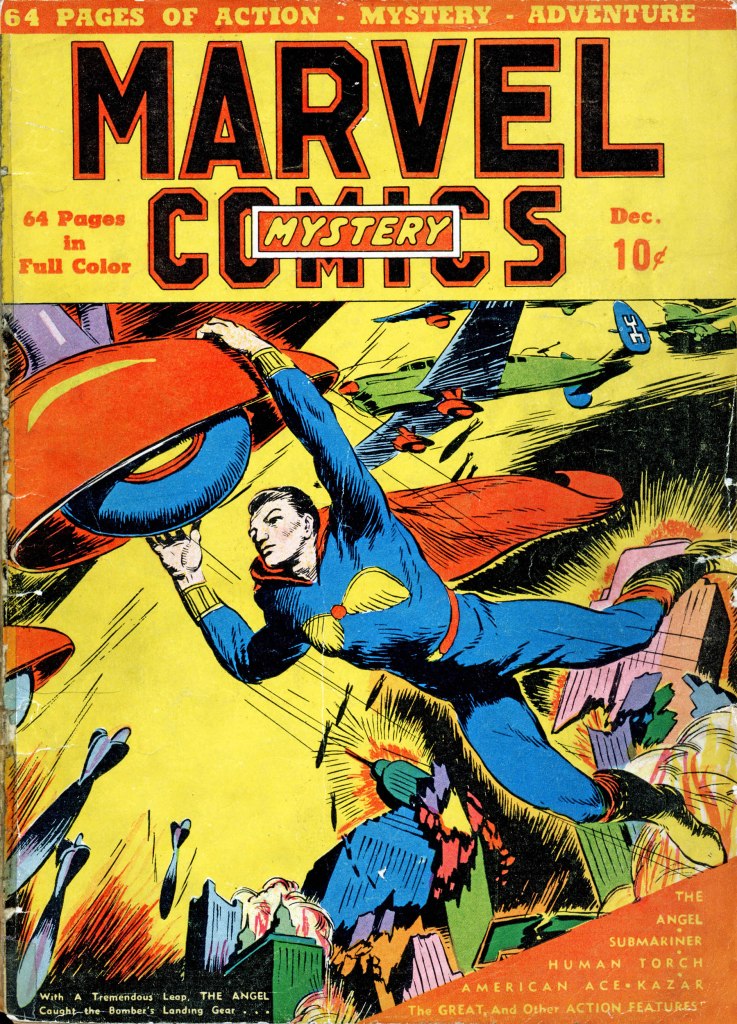
Marvel’s first title, MARVEL MYSTERY COMICS (called simply MARVEL COMICS in its first issue–nobody quite knows how or why MYSTERY was added to the title, or for what reason) was something of a surprise success for publisher Martin Goodman. He’d initially printed up only 80,000 copies and the print job was so bad that he thought he’d never be able to move them. To the contrary, that print run sold out in no time at all, inspiring Goodman to go back to press and print an additional 800,000 copies , this time handled by his usual printer, and those copies sold like crazy as well. So Goodman moved whole-hog into publishing more comic books, and Marvel became an ongoing concern. You can see that on this second cover, Goodman was deliberately trying to make his character the Angel look as much like the popular Superman as possible, which included removing his trademark mustache.
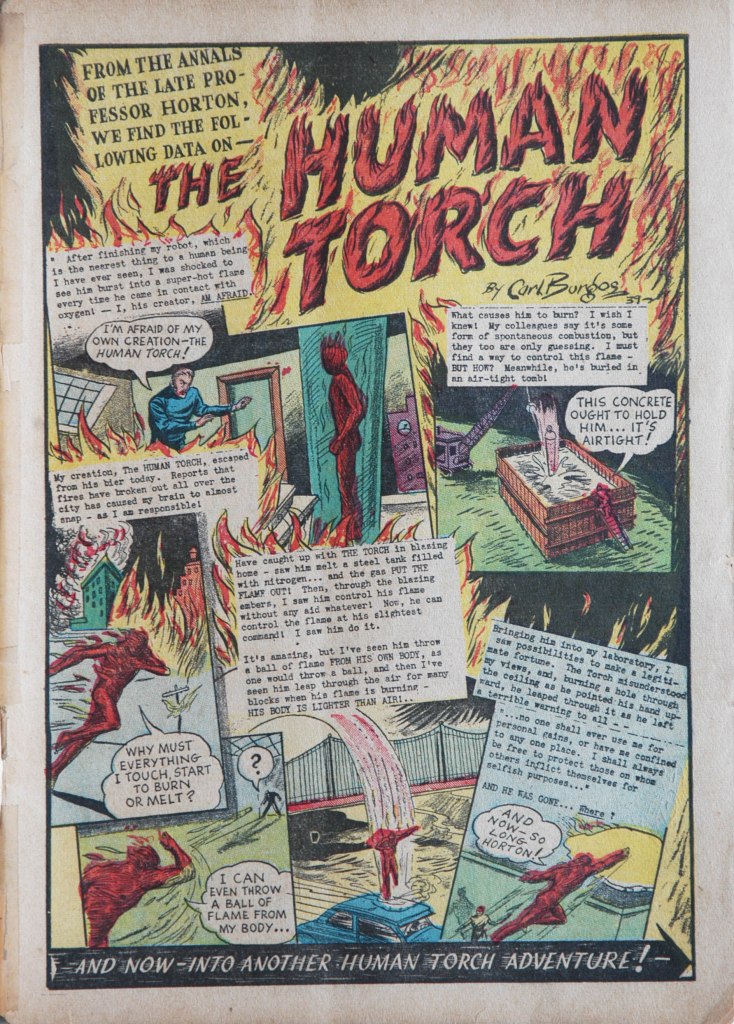
The headliner and first breakout star of the firm was Carl Burgos’ creation, the Human Torch. As has been remarked in many other places, the Torch was anything but human, being instead an android creation of a scientist who somehow burst into open flame upon contact with the air, yet never self-immolated. By the end of his first story, the Torch had learned how to control his flame, and he emancipated himself from his creator as a free being. And that’s where things pick up this time.
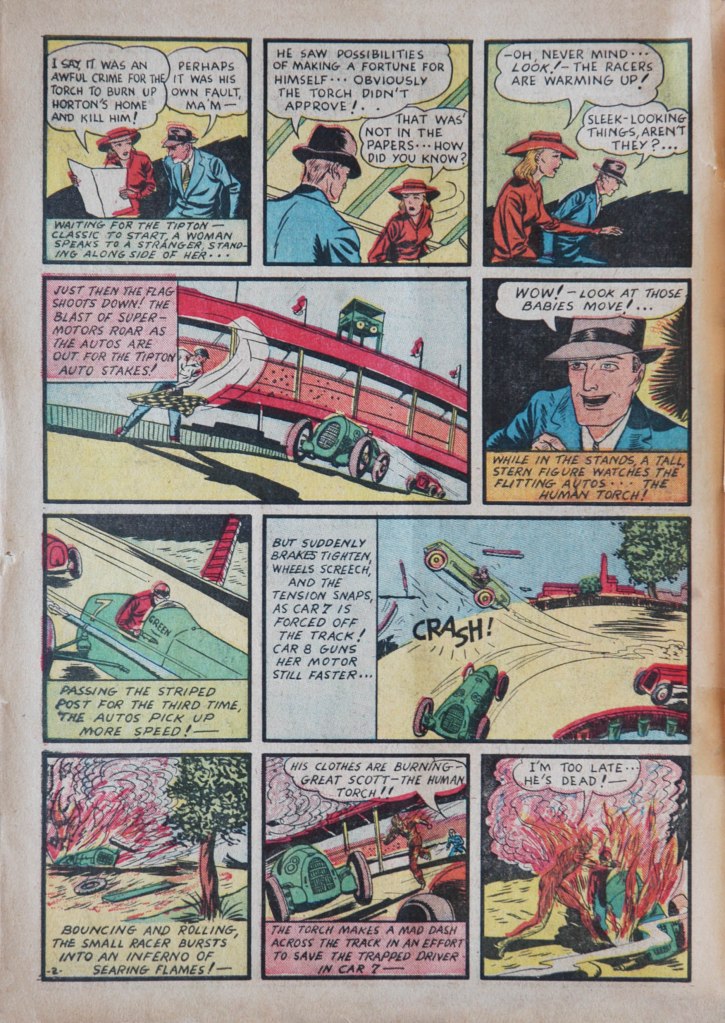
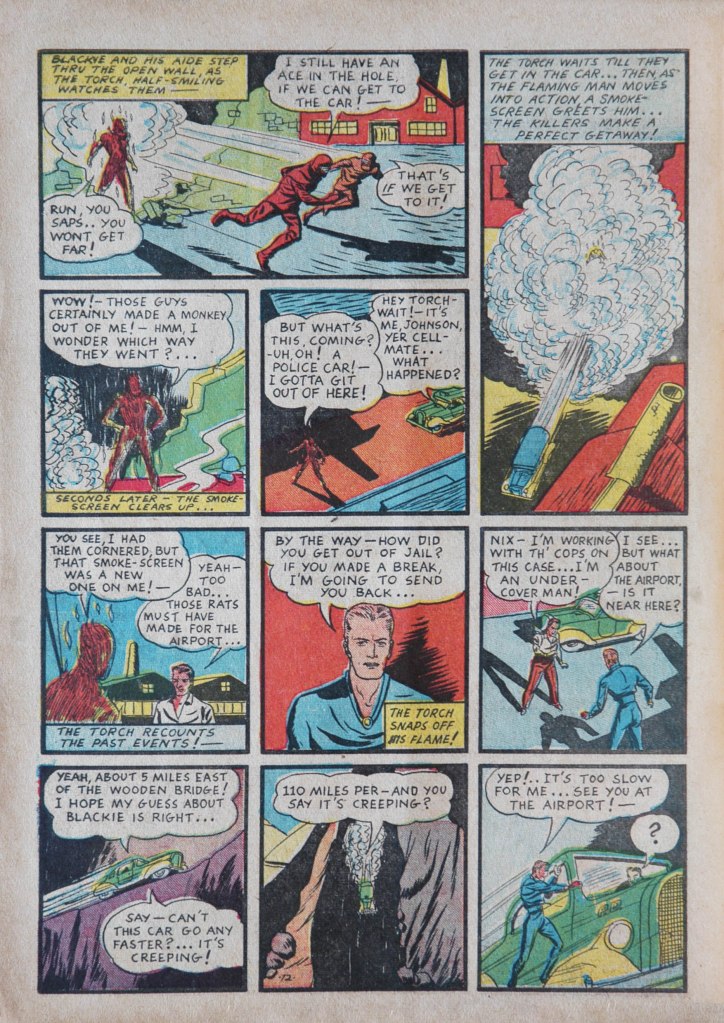
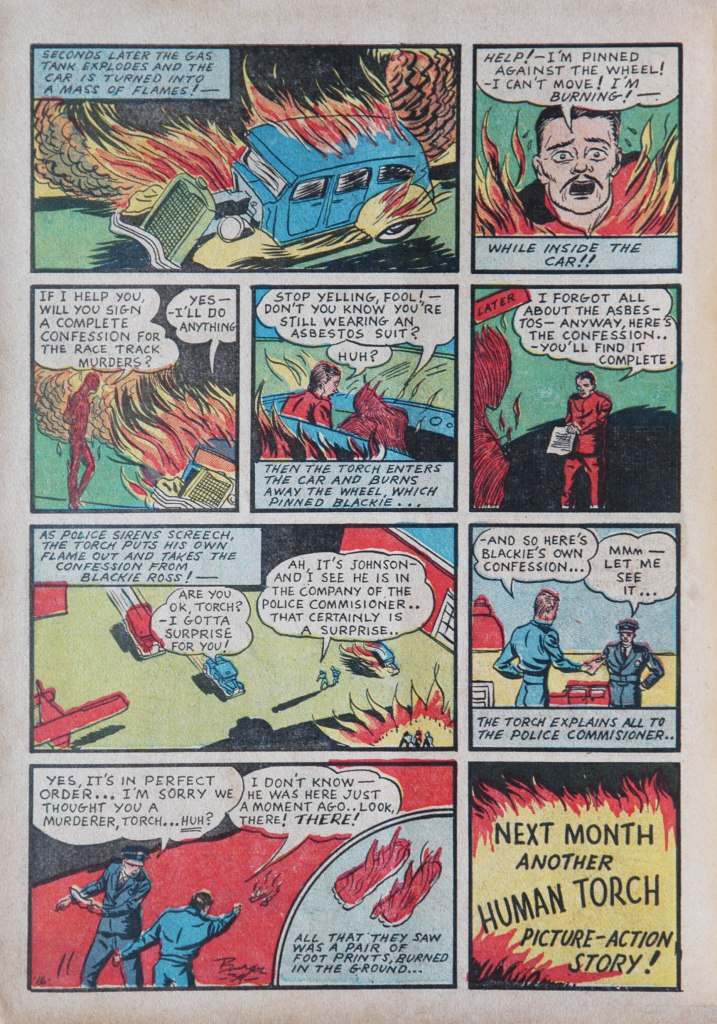
In this first story, it’s made clear that the Toch killed his creator Professor Horton in his departure, a fact that would be overturned in later retellings. Additionally, as seen here, the Torch has no remorse for his actions whatsoever. He does, however, leap to help the crashed driver of an automobile in a race he was just watching.
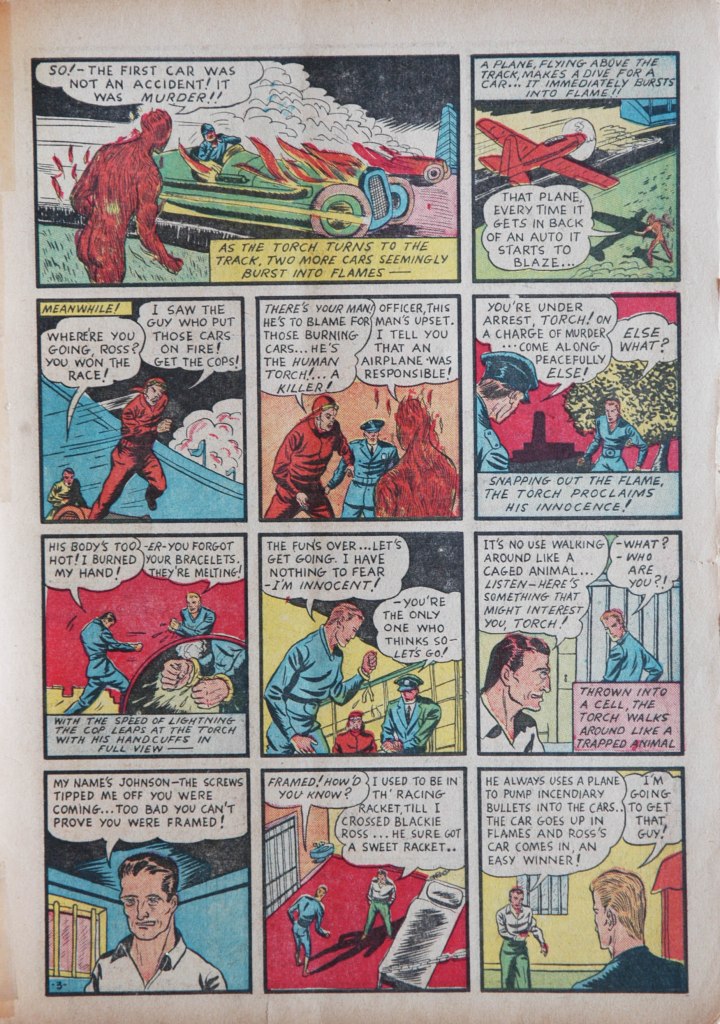
The Torch is, of course, blamed for the cars that suddenly caught on fire, and he’s arrested. Funnily, nobody seems much concerned about his murder of Professor Horton. Guess that guy wasn’t well-beloved.
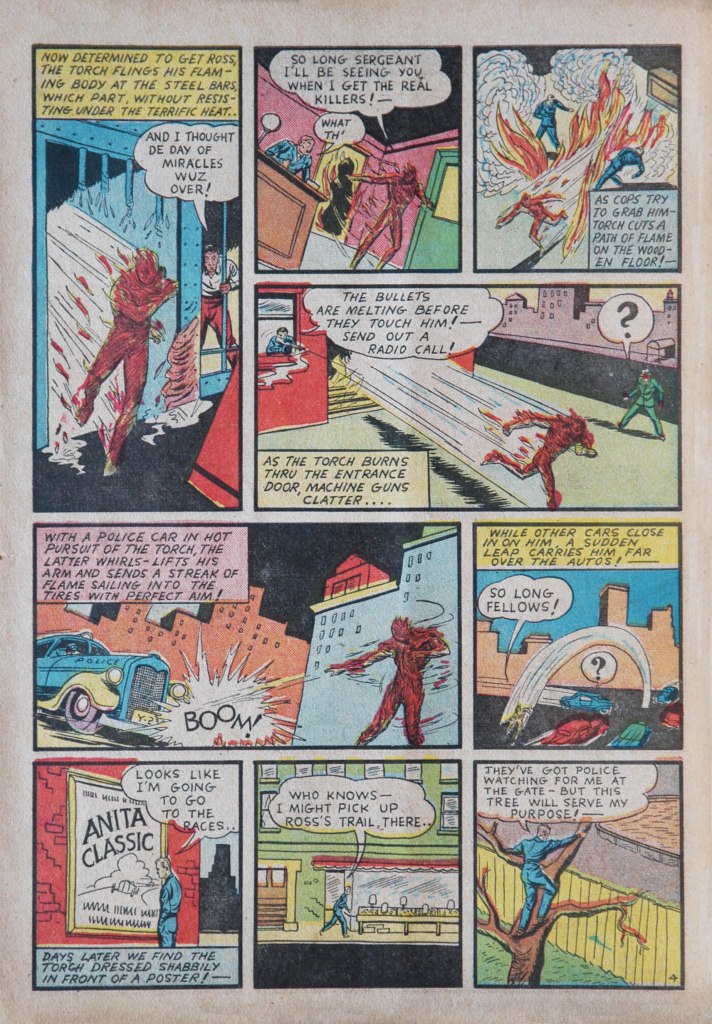
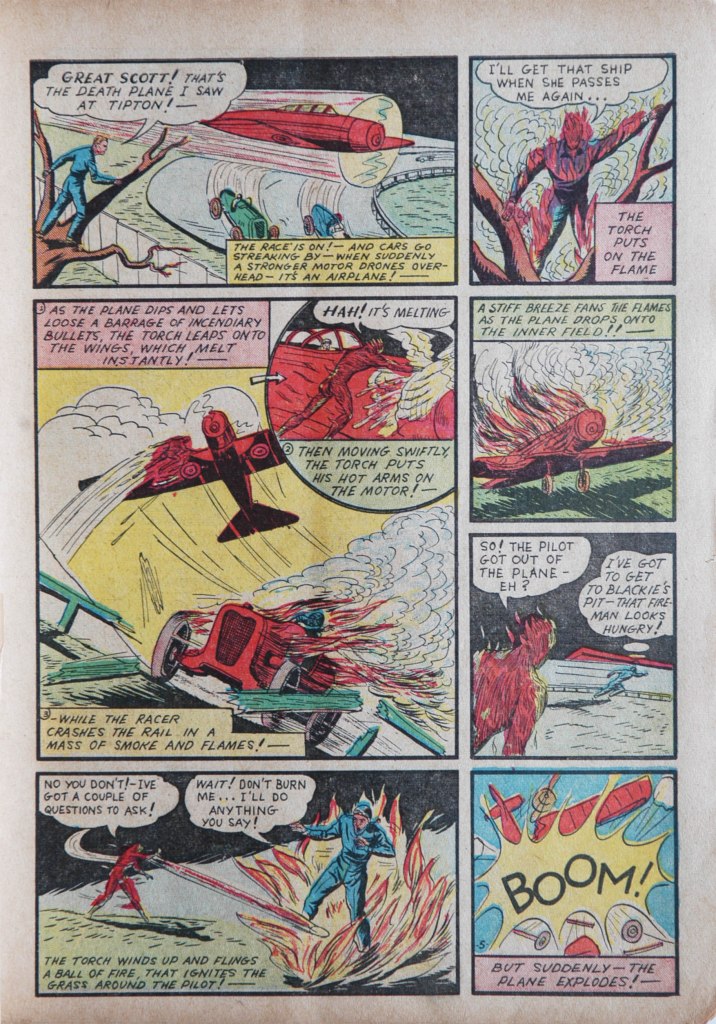
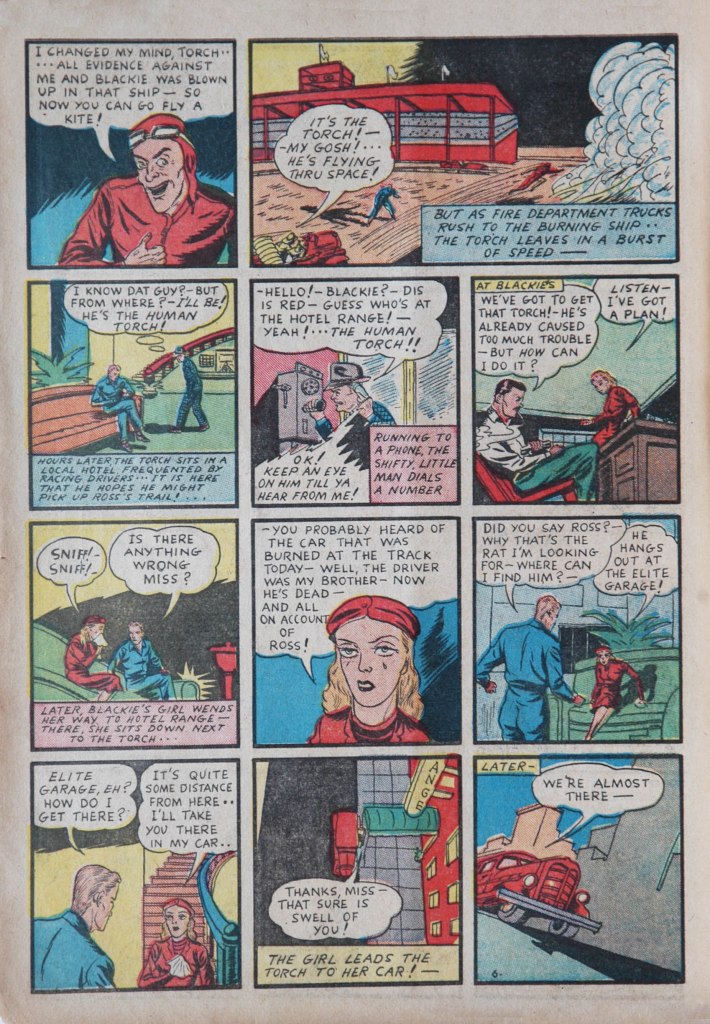
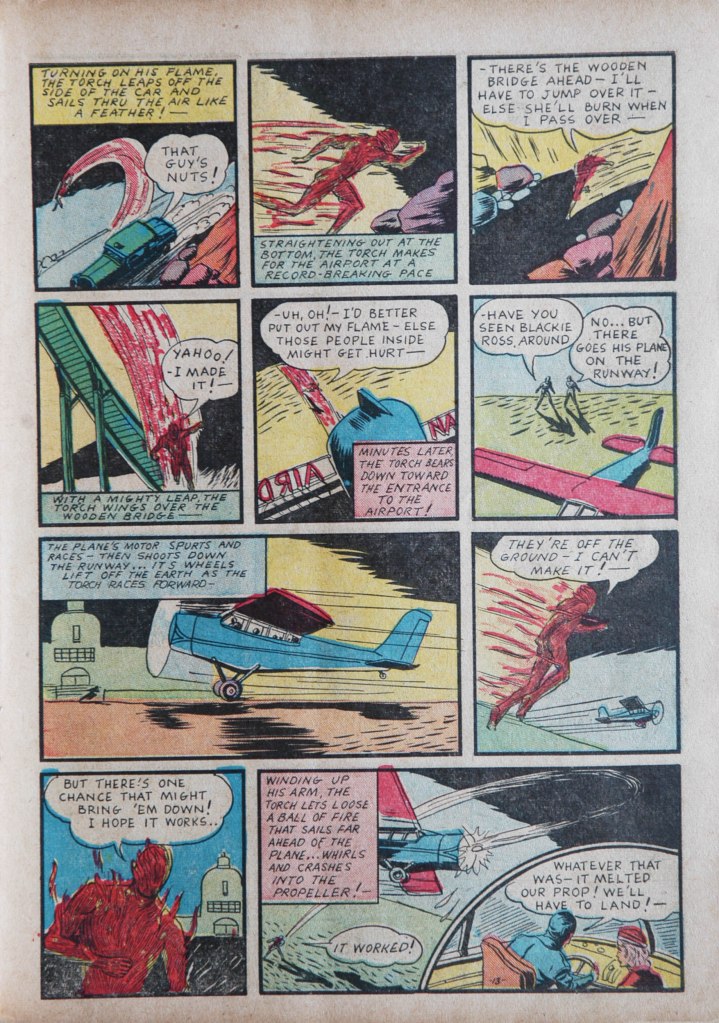
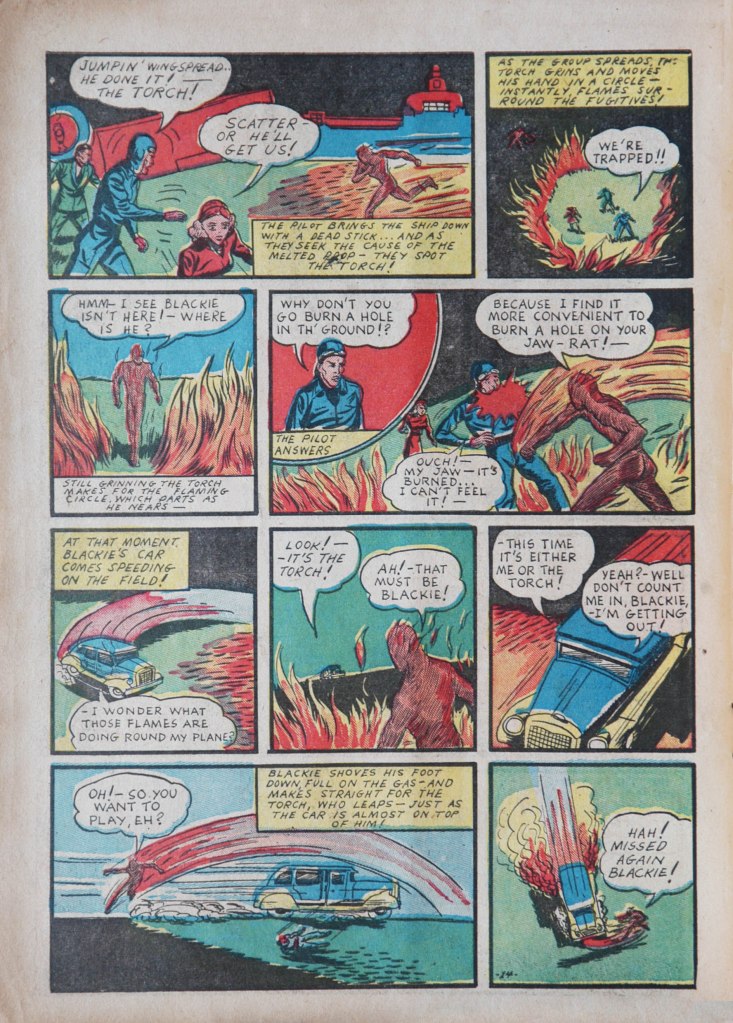
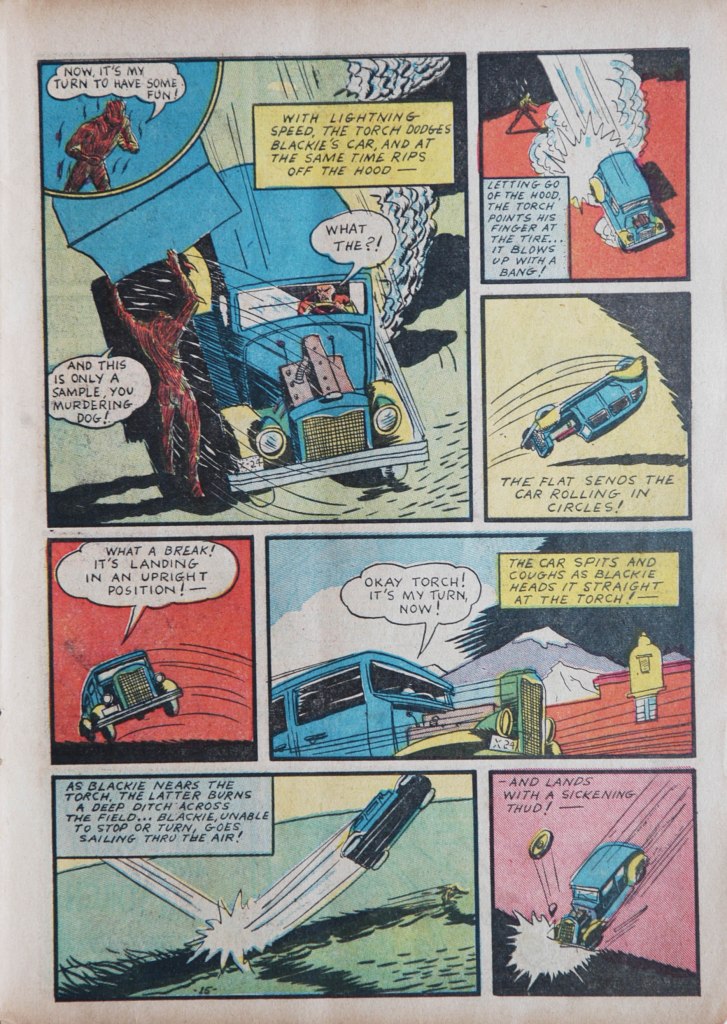
These early Carl Burgos pages are just packed with small panels in emulation of the Sunday comic strips of the day. It would take a while for most cartoonists of the era to break out of this mindset, and many publishers insisted upon it, thinking that their readers would feel that they were getting cheated if their pages held fewer panels. Consequently, this story is lacking in visual punch. Everything is just so small.
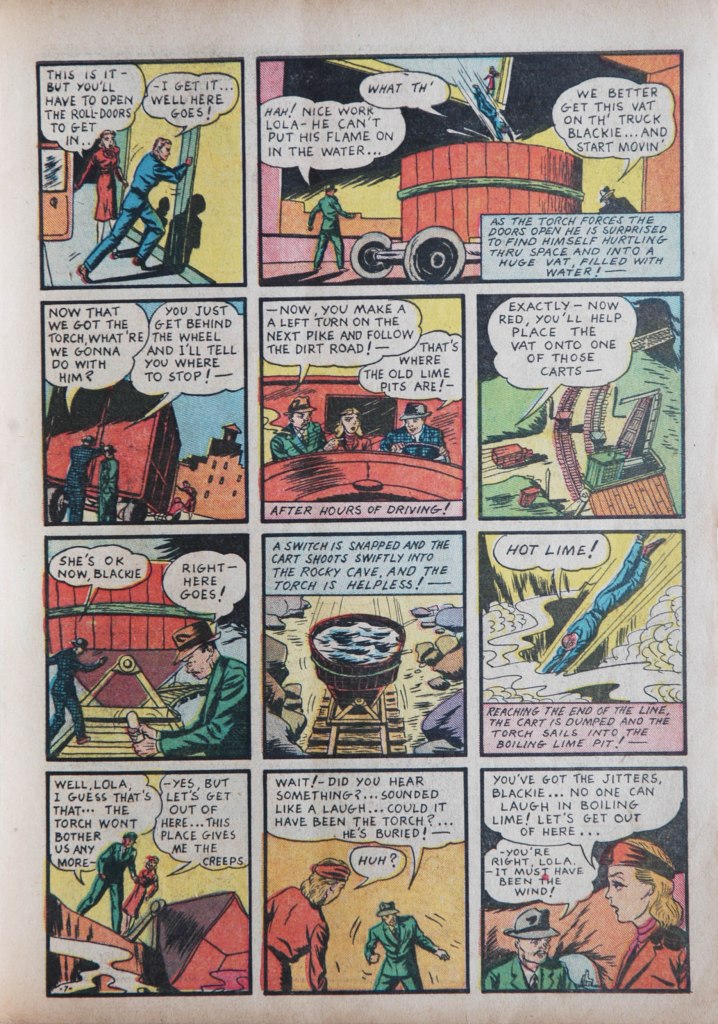
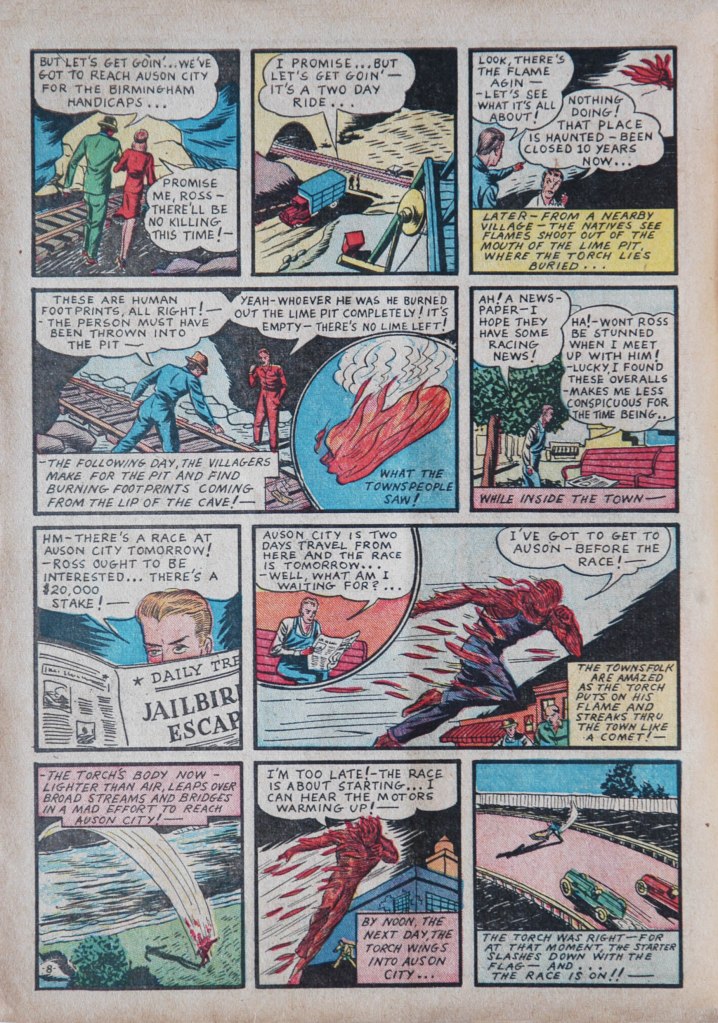
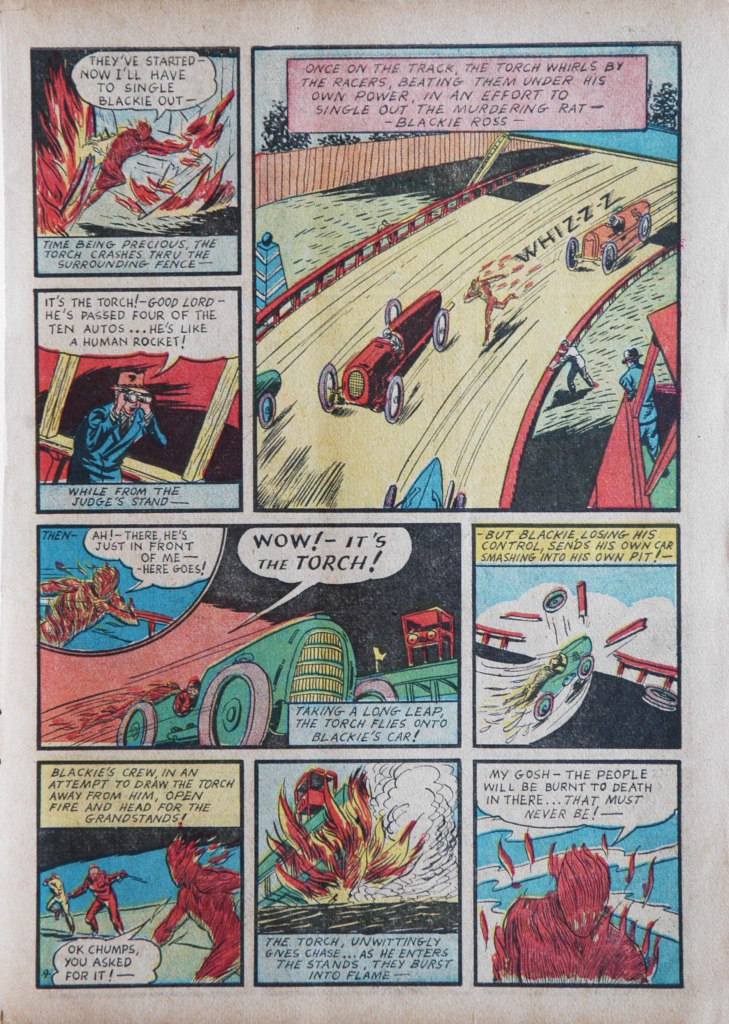
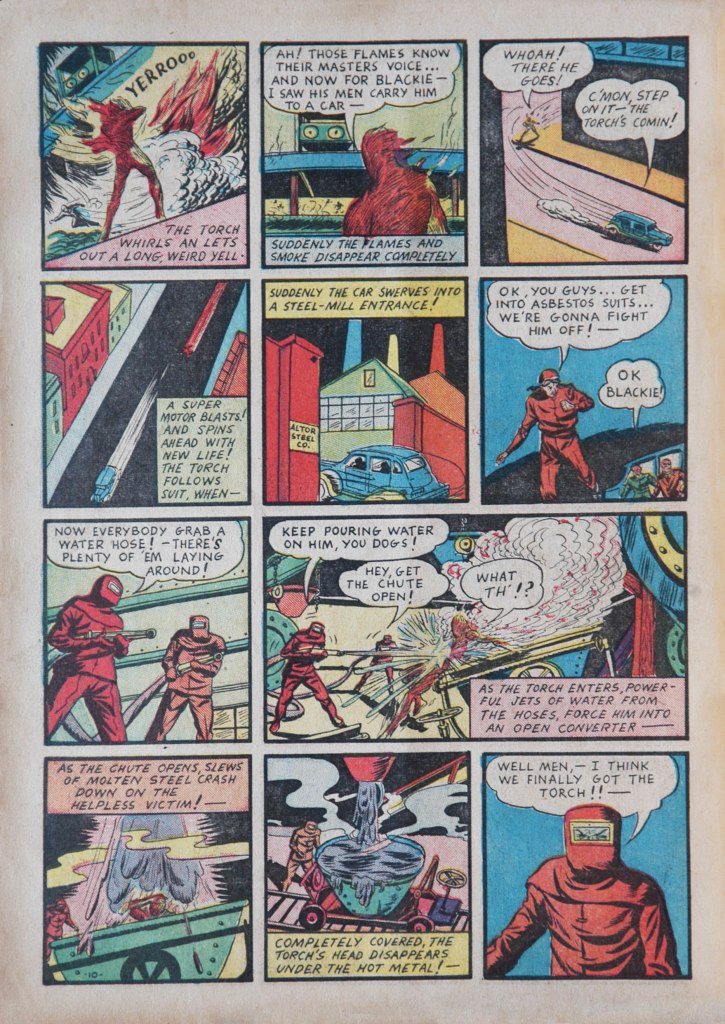
Also, nobody really seems to be amazed at the fact of a man on fire. The Torch is taken as a given at this point, just one story after his debut. This feels like poor judgment, but Burgos is more interested in keeping the plot moving than anything else.
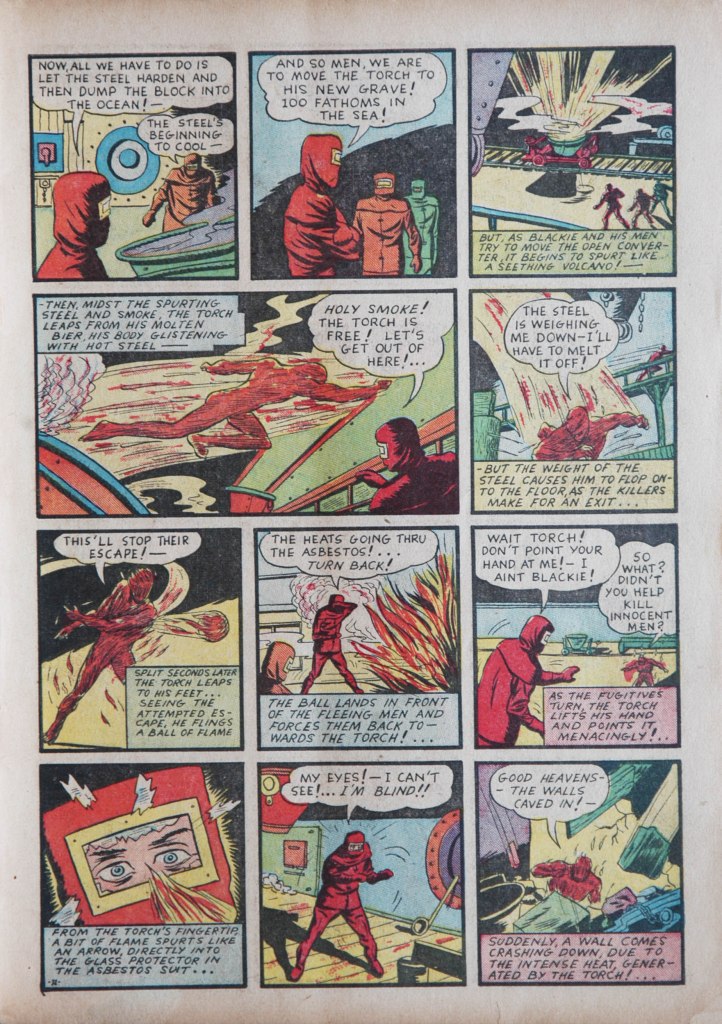
Goodman was apparently unhappy with the fact that you couldn’t see the Torch’s flame while he was aflame and told Burgos to change it, which he did in the story for issue #4. But soon enough, the Torch’s face was once more concealed by his flames, Goodman’s edict having been discarded. And it didn’t matter, for the character became popular enough to headline his own solo series before long.
 The Tom Brevoort Experience
It really set the tone for Marvel, with their top two characters both being wanted by the law pretty much right from the git-go. Though it didn’t last with the Torch.
I remember reading this stuff in researching MARVELS, and being struck by how they were figuring out the “rules” of superhero stories as they went along. The Namor series, in particular, reads a lot like a newspaper comic strip, with the story flowing directly from chapter to chapter, even when the next chapter appeared in a different title.
LikeLiked by 2 people
Hey Kurt, I’m a big fan of Marvels ( 1994 ). But I was disappointed that Alex Ross didn’t do as much work for Marvel as he did for DC Comics.
LikeLike
Well, he’s still working, and mostly for Marvel these days, so maybe the Marvel side will catch up.
Me, I’d like to see him do something he creates himself.
LikeLiked by 1 person
Great cover. Not just for its time. It reminds me of early work by Tom Yeates. When Tom Yeates was, like, 5 yrs old. 😉 Naw. Tom’s great but maybe wasn’t that good @ 5. 😅
LikeLiked by 1 person
hard to believe they printed 880,000 of them
Was there any difference in the 2nd print run?
LikeLike
These early Golden Age stories had so much pulp sensibility to them. Gangster villains and betraying blondes (which was the now long-forgotten cultural context of “Black Canary”). They actually underline brutality from the hero, and it’s considered completely fine in the story – “My eyes! I can’t see! … I’M BLIND!!!”, “My jaw – it’s burned … I can’t feel it! (third-degree burns!). Brr, the Torch is scary. The last panel seems like they wanted flaming footprints to be the I-was-here sign of the Human Torch, which is again something out of the pulps (and has costume Fridge Logic problems if you think about it – is he barefoot all the time? Or does he carry around flameproof shoes somewhere?). His initial power levels are notably lower, as like Superman, he can’t fly yet, only leap. His power over flames is inconsistent even within the story, since if he could stop the stand flames, all the car flames should not have been a problem.
Typo: “Goodman was apparently unhappy with the fact that you couldn’t see the Torch’s flame” – you mean “face” there.
LikeLike
Crude and tiny panels yes, but the golden age/pulp mayhem works for me. The roughness of the drawing gives it an odd sheen of german expressionism and/or predicts future underground comics weirdness and intensity. Also the last panel: “Picture-Action Story” makes me think they haven’t yet landed on what to actually call these things yet.
LikeLiked by 1 person
Johnson ( Pete Johnson – Marvel Mystery Handbook 70th Anniversary Special ) in this story is a important inspiration in the Torch’s life[ Marvel Mystery Comics#4 ( February 1940 ), 5 ( March 1940 ), 7 ( May 1940 ). Considering that the original Human Torch burned a hole in the ceiling of Professor Horton’s home to escape Horton’s dreams of getting rich off him, it looks to me like unless Professor Horton was suicidal he had plenty of time to walk out of his house before the fire spread[ Marvel Comics#1 ( October 1939 ) last page ]. What was the Professor’s plan to get rich of the Torch? Imitate Lt. Hercules the original Hero-For-Hire or like the decades later Spider-Man as an entertainer? I know that every life the original Human Torch would have gotten Professor Horton all the fame he could ever want ( Plus I don’t see Professor Zog the creator of Electro the Marvel of the Age not hiring him or even working with him ).
LikeLike
My hunch for why Burgos decided to kill Horton in story #2 is that there’s otherwise nothing stopping him from making more Human Torches…even though the first story strongly infers that he doesn’t quite seem to know what makes HT burst into flame? That said… Horton would have potentially made a great antagonist… hurling weird android after weird android at the Torch whether they could flame on or not. The Torch was an unlikely successful and surprisingly powerful prototype so the reasoning for Horton wanting to keep or capture him for selfish reasons makes sense.
As to how Horton would have gotten rich off the Torch if he was compliant: He’s a powerful weapon that could be sold to the military or to industry as a tool or power source.
LikeLike
The Marvels Project#1-8 ( 2009 series ) did link the original Human Torch and others to Project: Rebirth ( which has links to the military ) but they didn’t do a very good job doing it and they left out a number of Timely Comics heroes that could be linked to Project: Birth too ( Which I pointed out in Giant-Size Invaders#1 on this site — if I’m not mistaken ) or Imperial Japanese & Nazi Timely Comics counterparts to Project: Rebirth or DC Comics’ Project M ( for Monster — I just added this to original The Marvels Project disappointment thoughts ).
LikeLike
As for the golden age Angel being made to look as much like Superman as possible on the cover of Marvel Mystery Comics#2, well in his text story “Death-Bird Squadron” by David C. Cooke in this same issue he did Superman like things too: “..he had flexed his lithe muscles, and had bounded lightly to the top of the highest building in sight.” ” He sped through the black of the night with the speed of a high-caliber bullet. Closer, ever closer, he travelled toward the massive plane. And then he grasped it! The Angel’s nimble, but strong, fingers closed tightly around one of the wheel-pants on the leading bomber” ” …and then smashed his fist through the metal skin of the flying monster!”, “.Just this!” .. answered the Angel, picking up the pilot and throwing him straight at the figure of the gunner. The two men fell silently to the floor of the bomber, their skulls crushed like egg-shells.” & “The Angels cape waved blood-red behind his blue clad figure as he hurtled through the air and landed easily on the street below” ( He jumped of the bomber he was in after causing it to head on a collision course with another bomber ).
LikeLiked by 1 person
The Angel had a bit of a devil in him. I liked him better without the mustache. 😉
LikeLike
So do we think Angel got a power downgrade because Goodman belatedly feared a call from National’s lawyers?
LikeLike
“nobody quite knows how or why MYSTERY was added to the title, or for what reason”
Hmm. Seems like there should be a word to describe a situation where nobody quite knows how or why something happened!
LikeLiked by 1 person