

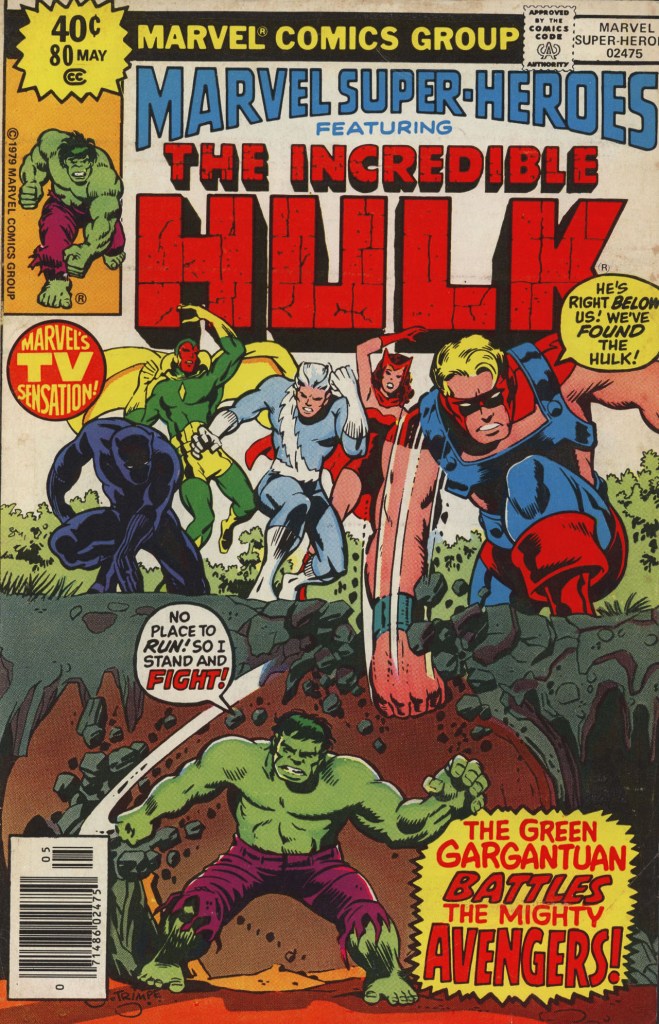
I picked up the next issue of MARVEL SUPER-HEROES on my next weekly Thursday trip to my local 7-11. This was probably the heyday for this reprint series. While most of Marvel’s other reprint titles had fallen by the wayside, MSH continued on without pause, buoyed by the popularity of the Hulk’s weekly CBS television series. (Hence the Marvel’s TV Sensation blurb on this cover.) Which was fine by me. As I’ve said before, I wasn’t a huge Hulk fan, but I generally liked the comic books of the era that was being reprinted, and so always bought the book when I came across it.

This particular issue contains a guest appearance from the Avengers, whose title writer Roy Thomas was also helming at the point when this story was produced. I’m pretty sure that this was my first exposure to the Clint Barton Goliath, who sported a costume that I really liked–so much so that I ripped it off for a couple of my home-grown characters in my own crude comics of the time. The thing is, I didn’t know anything about the character, and this issue didn’t give me any real clues. From his speech patterns, I could tell that he wasn’t Hank Pym, but who he was and where he came from was a mystery to me–one that would take me several years to get to the bottom of. Still, nice costume.
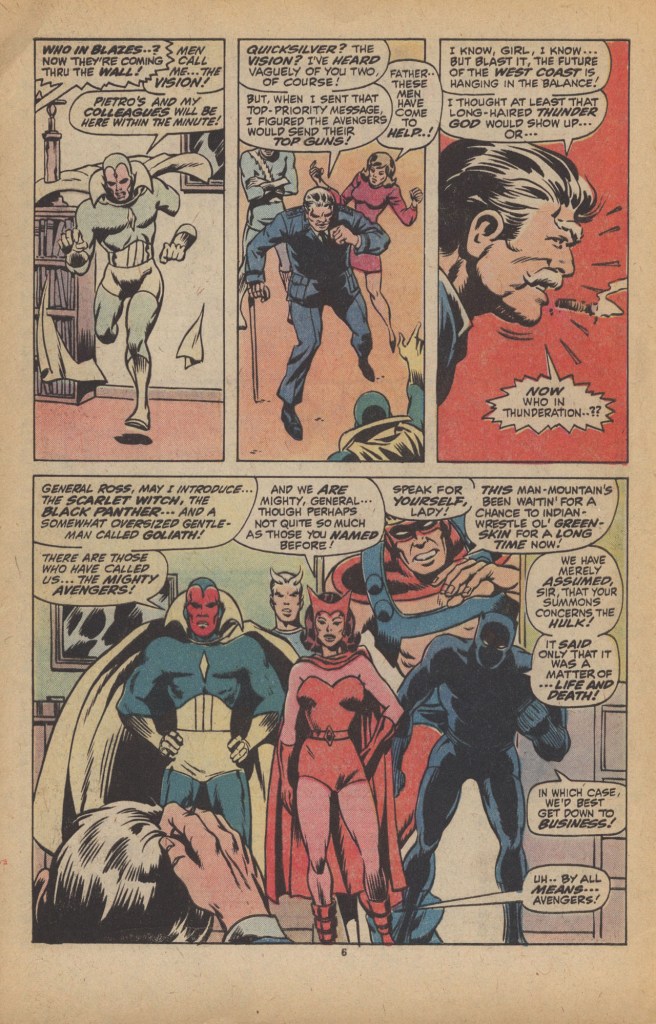
This issue opens with the Hulk returning from Subterranea, where he spent part of last issue’s adventure. Unfortunately, the path he’s taking will intersect with the San Andrea Fault, which holds the potential to unleash a devastating earthquake against the West Coast should the Hulk get angry. Thunderbolt Ross’s military battalion has become aware of this danger, but unable to deter the Hulk themselves, they’ve called for assistance from the Avengers. Ross is outspokenly disappointed not to get Thor, Iron Man or Captain America when the team shows up. But they’re game to take on the Hulk, and with the danger involved, Ross can’t be too choosy about whose help he accepts.
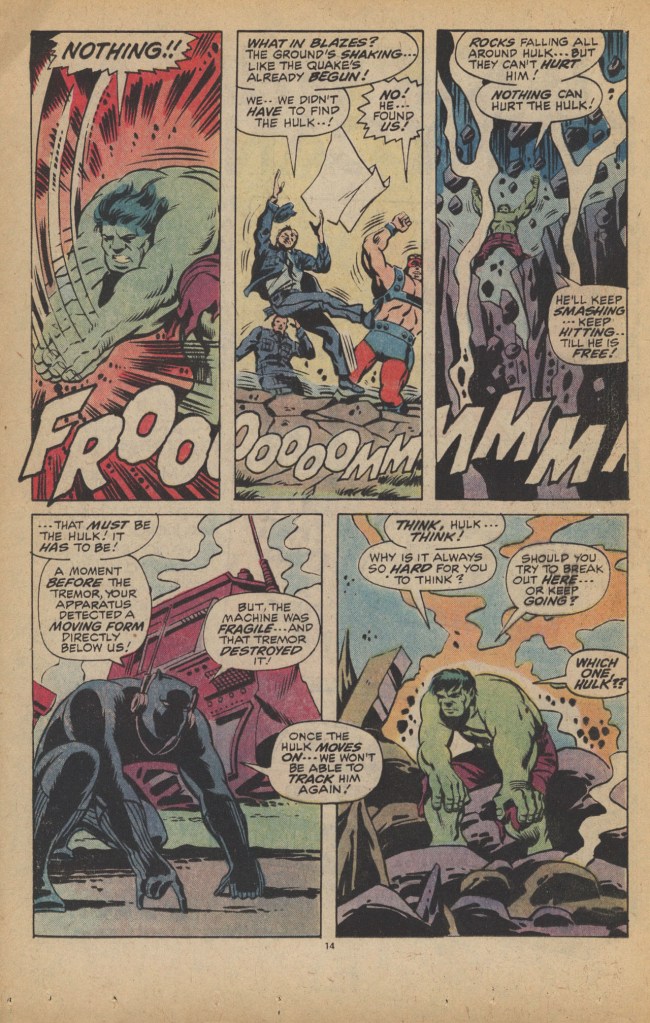
The Avengers and the military set up in the Hulk’s projected path. Ross has brought his lab boys’ new invention, the Gammatron Bombarder, which ought to be able to turn the Hulk back into his more harmless Bruce Banner alter ego if they can just get him into the thing. Te Hulk, meanwhile, is growing more and more frustrated by the miles and miles of endless caves that he’s been walking through, and he begins to lash out, causing greater concern for our heroes. Like it or not, they’re going to have to engage the brute who was once a founding member of their team before the consequences are disastrous.

The Vision is the first to engage with their quarry, sinking immaterially deep into the ground in order to intercept the Hulk’s path and lure him back to the surface. The Hulk is momentarily vexed by the Vision’s ability to become both insubstantial one minute and harder than diamond the next, and it’s an easy matter to get him to pursue the Android Avenger to the surface, where the rest of the team and the army are waiting.
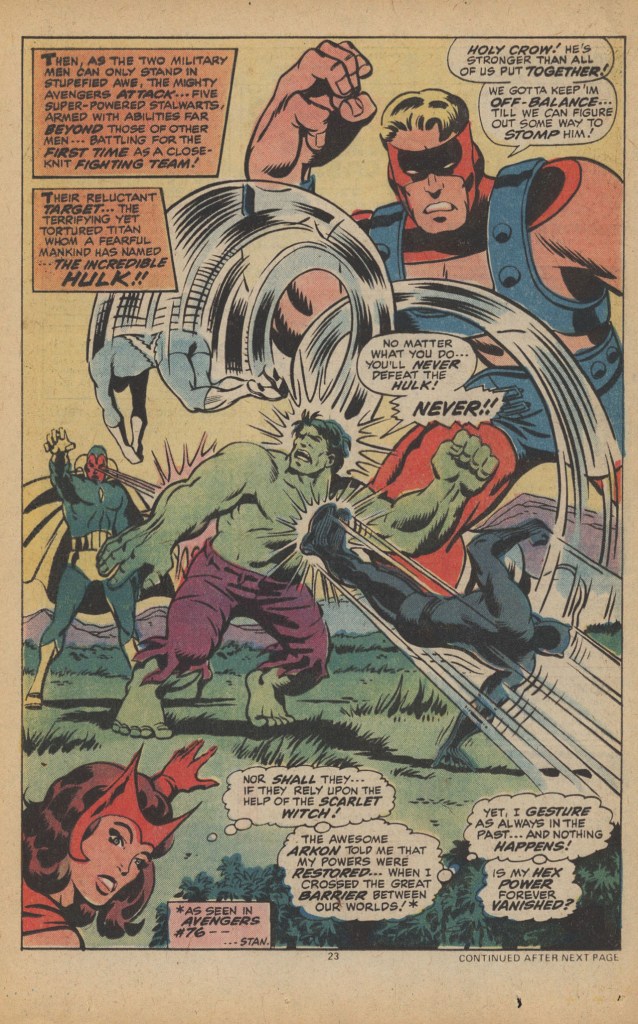
But ultimately, even all working together, the powers of Goliath, the Vision, the Black Panther, Quicksilver and the Scarlet Witch are only barely able to contend with the increasing might of their gamma-powered opponent. Roy also takes a moment to push forward a plotline that he’d been developing over in AVENGERS, in which the Scarlet Witch’s waning powers had been restored, so that she can now cast “Hex Spheres” in which unpredictable things happen. I don’t know that this was any more sensible than her traditional Hex power, and it was ultimately largely discarded–but in this moment, Roy trots it out for the first time, bedeviling the Hulk in unpredictable ways and giving the Avengers a chance to marshal their forces.

In the end, the Avengers are able to maneuver the Hulk int o the Gammatron device, but the brute is so angry by this point that he’s able to fight off the transformation that it’s attempting to force and leap away from the conflict. Still, California is safe now, so the Avengers chalk this up as a win, albeit an inconclusive one. And far from their eyes, we see that the Gammatron did have an effect on the Hulk, changing him back to Banner as he completes his great leap away. But that’s the set-up for the next issue, and for now, the Avengers head back into their own title.

This was the first book that I got that contained that month’s new Marvel Bullpen Bulletins page, in which the debut of newcomer Frank Miller on DAREDEVIL is touted. Stan, meanwhile, encourages the Marvel faithful to send comments concerning the company’s recent forays into live action and animated television to the addresses of CBS and NBC respectively. There’s also a long piece talking about how the editorial team had been rethinking Spider-Woman (who was soon to debut in her own cartoon series) and how they think they’ve finally cracked it. (Spoiler: they hadn’t.) And Jim Shooter reveals that he’s the one writing the Bullpen page at this point, apart from Stan’s Soapbox. That would continue to be the case well into the 1980s when the page became more haphazard and irregular.
 The Tom Brevoort Experience
That Goliath costume was also influential on Atlas’s costume in THUNDERBOLTS, and of course we brought back the “original” version for Hank in AVENGERS. Because I love that outfit too.
Ross’s complaint about not getting the Big Three Avengers may stem from Roy feeling similarly. Stan wouldn’t let him make those characters regulars again, and he was only allowed to use them as guest stars, something he did so regularly that I, reading back issues, wasn’t aware that they weren’t regular members until I saw Roy talk about it in interviews.
LikeLiked by 2 people
I like the original colour for Goliath’s costume [ looking at it on the cover of The Avengers#63 ( April 1969 ) right now on comics.org by Gene Colan and it looks good. ] and I remember when Kurt & George brought that version back for Hank Pym in Avengers#27 ( April 2000 – comics.org )? I assume the reason Stan Lee didn’t want Thor, Iron Man & Captain America back as regular Avengers was similar to why Jack Kirby at DC & later when he returned to Marvel — dealing with continuity ( Keeping up with what the characters were doing in yet another monthly series ).
LikeLike
Hi Tom,
You really liked the mostly-shirtless Goliath look? I always thought it was like Witchblade or Martian Manhunter: hard to stand around people wearing clothes without feeling a little silly and usually leaves them feeling chilly.
Love the blog!
Jesse
LikeLiked by 1 person
The first issue of Avengers that made it into my collection was #104, which coincidentally was Thomas’ last as regular writer and by which time Thor, Iron Man and Captain America had returned as near full-time regular members of the team for nearly a year, although I didn’t know that at the time. Right around the same time (maybe a few months later), I also started collecting Marvel Triple Action which at the time was reprinting early Avengers’ stories – the first I got was a reprint of Avengers 10, featuring Immortus’ debut and the main line-up of the team from issues 4-16, with, aside from the Big Three of Cap, Shellhead & Thor, Giant-Man and Wasp. It was a bit surprising to me to learn, much later, that Thor & Iron Man had not been regulars on the team for most of the period between 1965 through 1971, not appearing at all, aside from brief cameos from issues 17 – 50, and they and Cap only appeared irregularly from issues 51 – 93, when they began to appear much more regularly for at least the next decade. Reading some of those issues of the Englehart era, I caught references to Clint having ditched his Hawkeye guise for a time to play Goliath, although it wasn’t until I got a Treasure Edition that included a reprint of Avengers #83, the Lady LIberators issue, that I first saw him as such. Eventually, I also got this issue of MSH, with this particular line-up of Avengers. As I filled in the gaps in my Avengers collection, it struck me that the Avengers line-up tended to change in some way or another at least once every 12 issues or so, and there was a lot of flux even within the first few issues, with Ant-Man changing into Giant-Man with the 2nd issue, which ended with the Hulk quitting; Iron Man showing up with a the first major change to his armor in issue 3 wherein Hulk returned as an adversary teamed up with Namor; Cap being discovered floating in the ocean unconscious and joining the roster in #5; Wonder Man conning his way onto the team and getting himself “killed” in issue 9; and the big changeover in issue 16, with the remaining original members taking off to leave Cap in charge of their replacements — a trio of young former villains!
All of which brings up another funny point about this particular story from less than 10 years after Hulk himself had been an Avenger — at this point, to the best of my recall, none of these particular Avengers had ever encountered the Hulk before, despite 3 of them having been tasked with finding the Hulk to try to convince him to re-join as part of their first mission as Avengers. But just a few years later, Clint and Hulk would actually become teammates, however, briefly, as members of the Defenders!
LikeLiked by 2 people
I was never a fan of Clint as the strong man. He’s Hawkeye. I guess the Pym Particles add mass, but it seemed weird that Clint disproportionately bulked up. And the suit, with the harness, eh, no. I didn’t mind the harness look on Herc, though, decades later.
Anyway, I wasn’t really a fan of Giant-Man/Goliath, either. I thought it was appropriate when Erik Josten (Power Man/Smuggler) adopted the Goliath name as a villain in “Invincible Iron-Man” Annual # 7. Great story by Bob Harras, and excellent art by Luke McDonnell. .
LikeLiked by 1 person
“Ross is outspokenly disappointed not to get Thor, Iron Man or Captain America when the team shows up. “
Him and me both. I love the Kooky quartet and the return of Hank Pym as Goliath… and there are still some great stories peppered in the Avengers until the Big Three really return…..but during this period they tend to come off as either substitutes at best or leftovers at worst without them.
LikeLike
Love that Ditko style fist in the splash.
That one Silver Surfer issue (the final one, an abortive makeover as an angry Surfer) Trimpe inked over Kirby was so great. IIRC it was the only time, which is a shame. They could have made beautiful music together, as the saying goes.
LikeLiked by 1 person
I can understand Stan Lee decision to keep Thor & Iron Man and, later, Cap, out of the team during the period when he was essentially trying to mold the various superhero mags into one coherent narrative, which was difficult when Thor was off on one big adventure after another in Asgard, outer space or wherever else, while Iron Man was involved in his own globe-spanning multi-chapter adventures, and for a time, Cap’s adventures in Tales of Suspense were set in World War II to avoid continuity conflict in the then “present” of the mid-60s. Now I don’t know what my outlook would have been if, say, I’d started reading the Avengers anywhere in the period between issues 17 and 48, when Cap was the only one of the Big Three who appeared regularly, but certainly by 1972, Cap, Thor & Iron Man were the big shots of the team and their presence provided greater gravitas to their adventures and pretty much forced the writers to include more epic, multi-issue stories to make good use of them and the other members. In the 1960s, Kirby was the main provider of epic storylines, but Kirby couldn’t work on every mag every month! Ditko could come up with multi-issue epics for the Hulk and Dr. Strange and, to a lesser degree, on Spider-Man, but I doubt he had any interest in doing a team book and to my knowledge he never did. Heck didn’t seem to have the imagination to come up with grand epics and Lee didn’t seem capable of coming up with epic storylines entirely on his own that didn’t seem like a retread of something Kirby or Ditko had done before or otherwise somewhat lacking. Thomas tried, but usually his efforts didn’t come off that well unless he was working with someone like Adams who had a very fertile imagination of his own. The Mutant Master storyline in the X-Men may have been epic in scope, but it certainly wasn’t all that great! John Buscema at least gave the Avengers a more epic feel to the art and he and even brother Sal helped provide a greater sense of grandeur to the goings whenever the Big Three showed up from issues 51 – 92, but it was really Adams, IMO, who upped the ante on the Kree-Skrull War to make that the Avengers’ first grand epic storyline, demanding the return of the Big Three to the fold, and even after his departure, John B, Barry Smith and Rich Buckler mostly kept up the momentum for the remainder of Thomas’ run. Englehart had a bit of a shaky start, but I think he really began to come into his own with the Avengers/Defenders clash and, about a year later, the Kang Wars, along with the ongoing mystery of Mantis.
LikeLiked by 2 people
I started with the Kooky Quartet era, then dropped the book (money problems) long before Hawkeye turned to Goliath. When I borrowed some of the books from a friend, I had no idea this was the Hawkeye from the earlier issues.
Having Hulk’s latest foe head off while Bruce Banner is lying unconscious was a common trope in this era. Though here it wouldn’t matter much if he were passed out as Hulk instead of reverting back.
LikeLiked by 1 person
I remember the San Andreas Fault being a big thing there for a while. Like quicksand and the Bermuda Triangle in media, it now is something I look back it wonder why it was so ubiquitous,
LikeLiked by 2 people
The growth serum that Hawkeye used to become Goliath [ The Avengers#63 ( April 1969 ) ] was a more powerful version that Hank used. Hank hooked Hawkeye up with a serum [ The Avengers#345 ( March 1992 ) ] that Hawkeye as Goliath again says Hank’s test say could give Hercules a run for his money ( but his fight with Goliath ( Erik Josten ) – Avengers West Cost#92 ( March 1993 ) – says that fight wouldn’t last long ). Question I have is why Hank Pym never hooked his old lab assistant Bill Foster up with the more powerful growth serum Hawkeye used?
LikeLiked by 2 people
This was the third Hulk book I ever had. As someone new to the Marvel Universe seeing the Avengers, some of whom were not familiar with at that juncture was very exciting.
Love the 35cent Starburst w/the 40 cent price. Well make that in retrospect. Back then my weekly budget was $2. At 35 cents each I could get 6 books for 2.10. Finding an extra dime could be done by checking payphones or other ways. However the extra 40 cents for 6 books a week proved nearly impossible thus most of the time I was down to 5 books 😦
P.S. Scan of the book looks great. When they are “bleached” detail of which little exists in the first place is entirely lost. The paper quality from 1978-1980 was pretty much newsprint so books were never white to begin with.
LikeLiked by 1 person
Since I may be one of the few fans of the Wolfman/Gruenwald/Infantino SPIDER-WOMAN, I liked that little window in Bullpens past. Though Shooter’s screed was first and foremost to goose sales on SPIDER-WOMAN, there’s no particular reason to doubt his testimony that a bh of Marvel people met for a skull session on how to make the book more popular (and thus keep it around for the projected TV show to make even more popular, in theory).
The big question is, though–why was Shooter hyping SPIDER-WOMAN 14 in particular, presumably as the fruit of the skull session?
The main story concerns S-W teaming up with the Shroud against the Cult of Kali. Not exactly entities that Marvel Assembled was begging to see again. It’s a perfectly serviceable story but there’s not much to set it apart from what had gone before. It also includes the debut of SW’s BFF Lindsay MacCabe, who would rather surprisingly stick around for the remainder of the run despite the various changes in editors and writers.
Fourteen is one of the first issues, though, that puts the heroine in contact with an “encounter group”– how seventies was that? This eventually leads Jessica Drew to the discovery that she gives off pheromones that repulse a lot of ordinary humans. Before, as far back as the origin, there had been intimations that she turned people off with her spidery qualities, but going by my re-reading of the series this year, Jessica’s experience with the Hatros Institute at least got her away from all of Wolfman’s stuff about “Spider-Woman, Dark Angel” and suchlike. Now, that minor change still wasn’t enough to make the book popular, though it managed to limp along until issue #50. But to my mind, Jessica’s eventual discovery of the role of the pheromones in her life seems to be the only real change to have been launched in issue 14.
LikeLiked by 1 person
I loved Infantino’s Spider-Woman! And wasn’t it free of Gruenwald’s continuity corrections thinly disguised as stories? I even enjoyed Infantino’s work on Spider-Woman much more than I did his return to the Flash years later. The image from one issue with Jessica with a towel wrapped around her hair has stuck with me for decades.
LikeLiked by 1 person
The word “bh” was meant to read “bunch.”
LikeLiked by 1 person
Oh, like “The Brady Bh”. 😉
LikeLiked by 2 people
I may as well add that even if Stan Lee’s main purpose in banning the Big Three from the Avengers was to lessen continuity snarl-ups, he did Roy Thomas an immense favor for forcing him to build up the characters who didn’t have their own titles. Would Thomas have concentrated as much on the two main character arcs of the sixties and seventies– the Vision/Wanda romance and the twisty relationship of Hank and Jan– if he’d been making room for the Titans Three all the time? Methinks not. It probably would have read something like the overstuffed ALL STAR SQUADRON.
LikeLiked by 1 person