


I’m not 100% certain after all this time where I got this issue of DEVIL DINOSAUR #1 from. I think it was probably another cast-off of David Steckel’s that he didn’t want and so gave to me. But I also have a similar vibe concerning my other comic book reading friend of the period, Don Sims. Either way, I know for certain that I didn’t buy it myself, and I didn’t give up anything to acquire it. It was a book that somebody didn’t wand and so I took. DEVIL DINOSAUR kind of had that reputation in the 1970s, as the very last gasp of the flickering ember of Jack Kirby’s creativity. In retrospect, it’s been reassessed and is now way more respected than it ever was in its native era. But I suppose most Marvel fans of the day were like me, wanting standard super heroes and only standard super heroes.
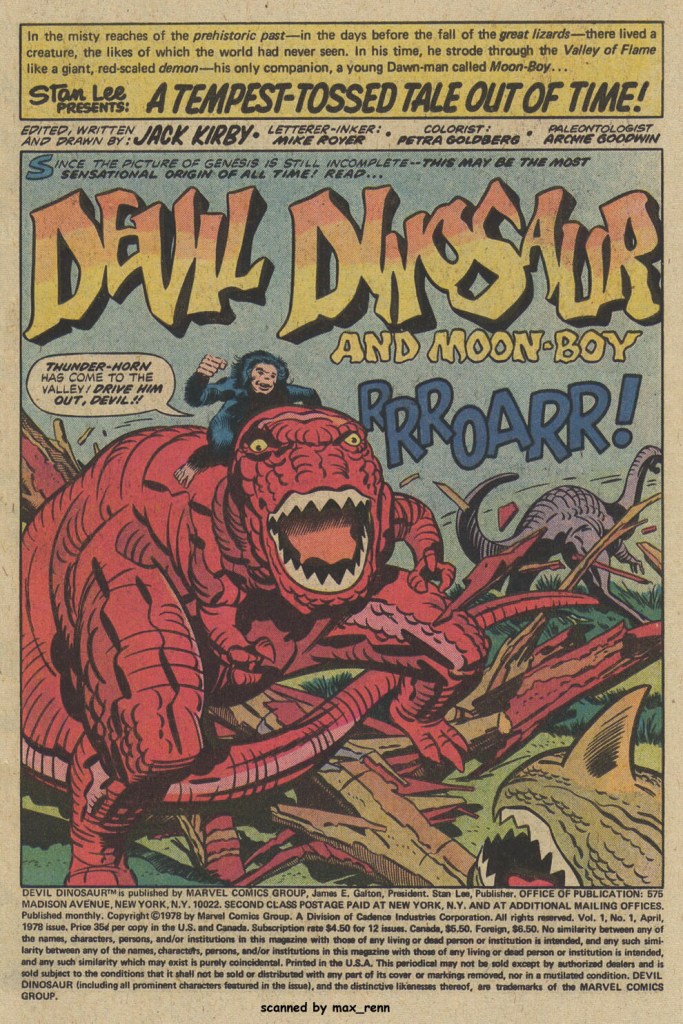
DEVIL DINOSAUR was the very last headline series that Jack Kirby ever created for Marvel. As I understand things, with space still left on his contract following his departure from CAPTAIN AMERICA, Jack needed a new book to do. At the time, Kirby’s DC property KAMANDI was being shopped around as an animation property, and so somebody at Marvel thought that a similar series might likewise be saleable to television animation. So Jack was asked to come up with “something like KAMANDI”. DEVIL DINOSAUR is really only like KAMANDI in that it takes place in a tie and place not our own–it was never Kirby’s style to repeat himself. But you can see the connection. Kamandi was “The Last Boy on Earth”, and DEVIL DINOSAUR co-stars Moon Boy, who is effectively the first.
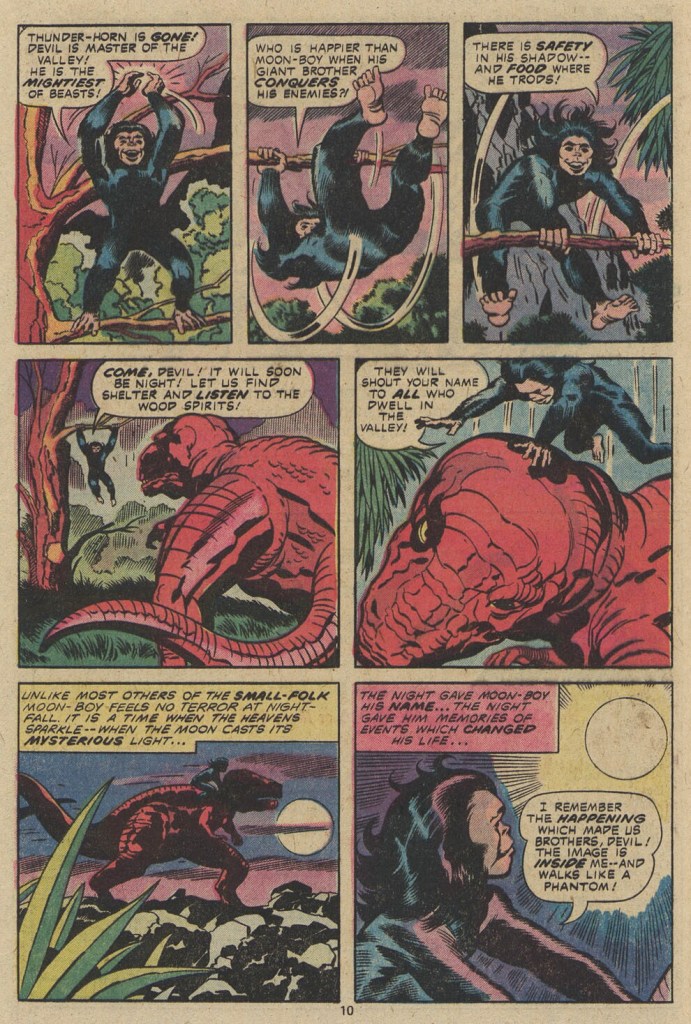
DEVIL DINOSAUR is set in prehistoric times, and features the adventures of Devil, a monstrous dinosaur with bright red skin, and his friend and cohort Moon Boy of the Small-Folk, the first proto-human beings. It’s a past that never truly happened, with dinosaurs and early hominoids (and eventually aliens) all existing at the same time. But it was definitely a canvas in which the full power of Kirby’s visual imagination could be unleashed. His dinosaurs never quite matched the historic record, but as creatures of the imagination, they had a power and a weight that made them very dramatic figures. Kirby is aided here by Mike Royer, who had been inking and lettering Jack’s work since partway through his Fourth World books at DC. Royer was about the most faithful, literal inker Kirby ever had–he was adept at reproducing the exact lines that Kirby had put down without any real embellishments of his own. Accordingly, the artwork is more stylized than the slick, clean renderings of a Joe Sinnott, and far more complete than any job a Vince Colletta ever turned in.
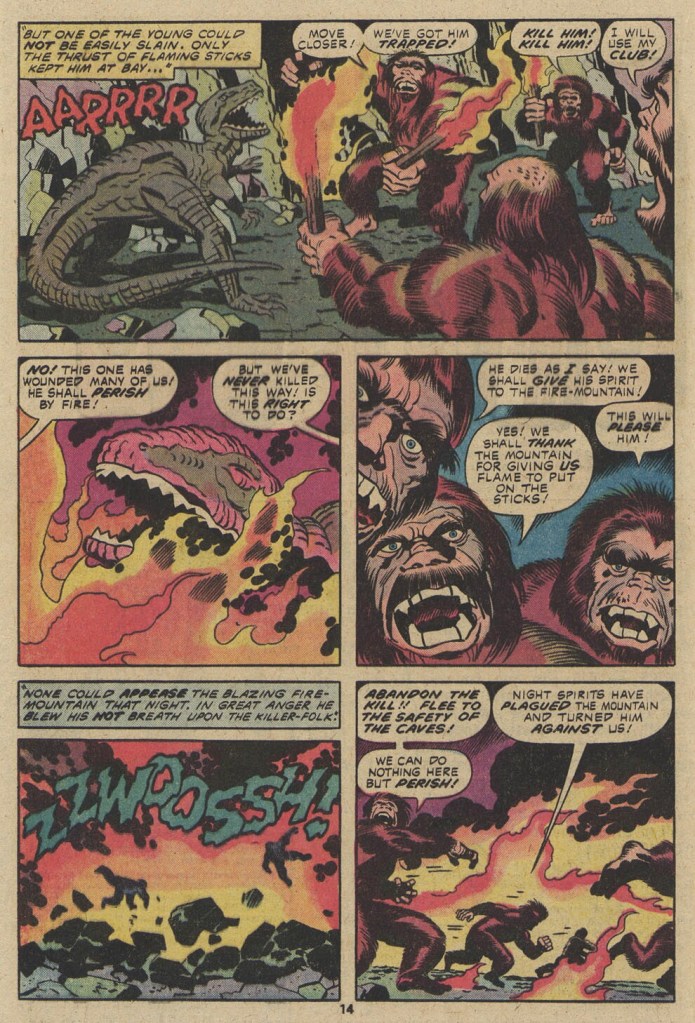
Plotwise, this first issue is a bit on the thin side. It opens with Devil facing the attack of Thunder-Horn, a giant Stegosaurus who has come to raid the Valley of Flame where Devil and Moon-Boy reside. With Moony cheering him on and providing a running color commentary, Devil clashes with his mighty foe and is able to drive him away. Enthused in victory, Moon-Boy thinks back to how he and Devil became brothers in the first place. It was in days past, when Moony had snuck away from his Small-Folk tribe to get a better look at Fire Mountain, an active volcano. In its shadow, he finds a tribe of Killer-Folk, somewhat more Neanderthal creatures, that have killed a mother dinosaur and most of her children. One young dinosaur still fights, though, and in order to conquer it, the Killer-Folk set it aflame.
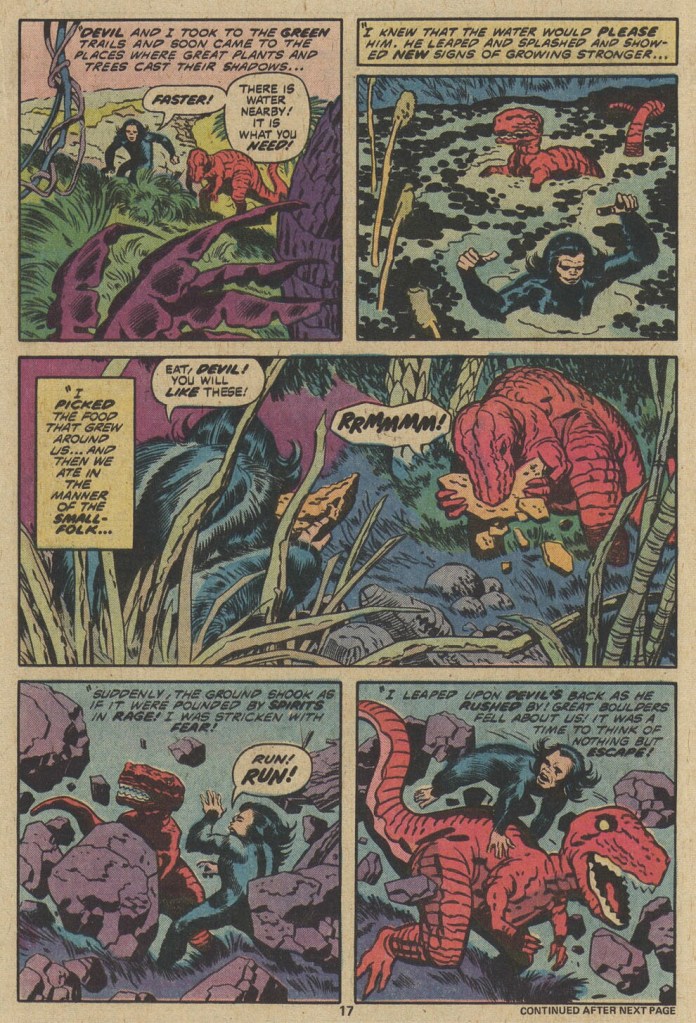
But an eruption of the volcano scatters the Killer-Folk before they can finish the job. Still, the dinosaur’s hide has been scarred a bright red from the flames it has withstood. As moon-Boy draws closer to the stricken beast, he is suddenly attacked without warning by a Leaper, a fast-striking lizard-dinosaur. But devil comes to his aid, grabbing up the Leaper in his powerful jaws and flinging it away into the distance. From this point, Moon-Boy (so-called because of his fascination with the moon in the night sky, a dreamer) and Devil Dinosaur are inseparable. But the Small-Folk tribe are frightened of Devil, and drive the pair from their village. So Moony and Devil are now a double act against this strange and hostile world of yesteryear.
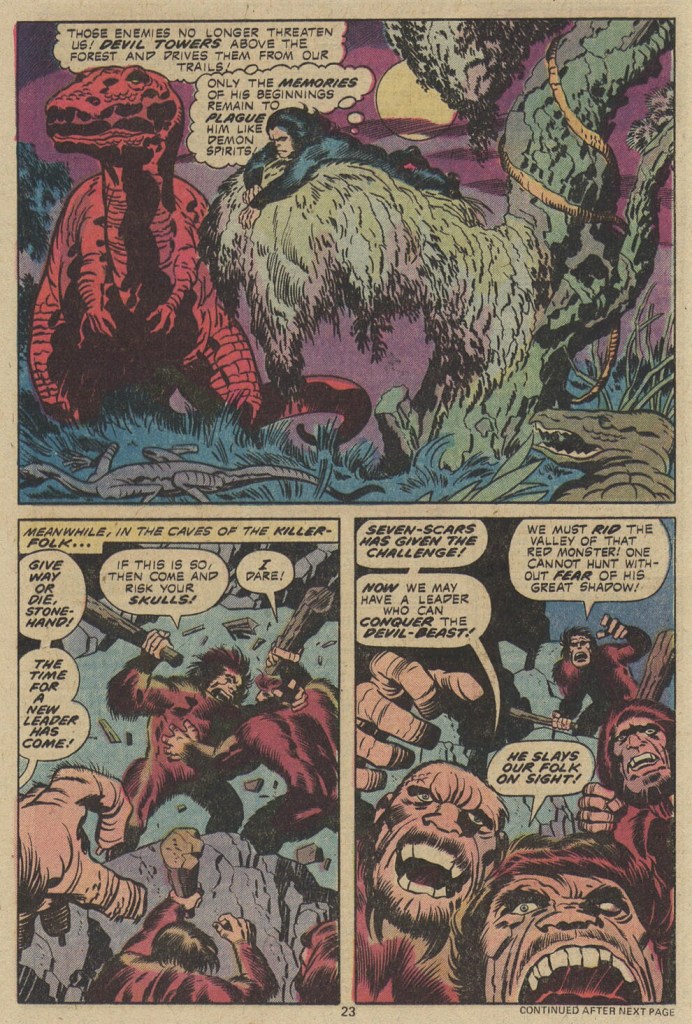
Back in the here-and-now, there’s a contest for leadership of the Killer-Folk between current leader Stone-Hand and a challenger, Seven-Scars. The Killer-Folk are looking for someone who can put paid to Devil Dinosaur, who demolishes them on sight and prevents them from overrunning the Valley of Flame and taking everything they want. Seven-Scars brutally slays Stone-Hand, and he’s got a plan to deal with Devil as well. To bring Devil to them, they light the forests of the Valley on fire, sending all of the assorted beasts on a mad rampage to escape the flames. And the Killer-Folk have built themselves a spike-filled pit, into which they hope to lure their red tormentor and bring him to an end. That’s where the story in this inaugural issue wraps things up.
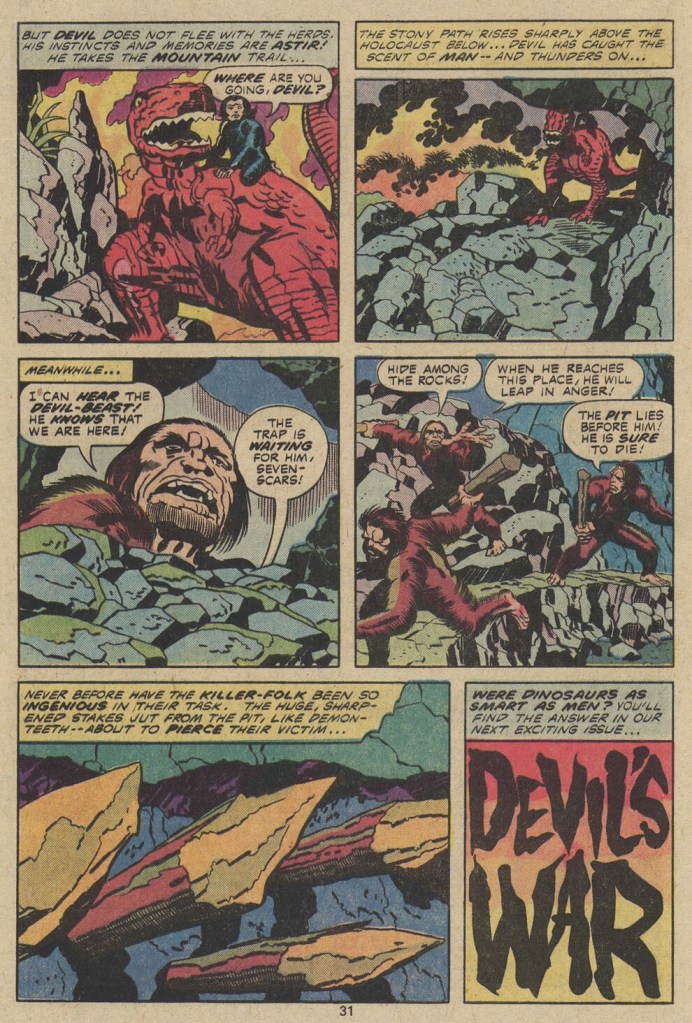
DEVIL DINOSAUR was definitely an outlier in the Marvel publishing line of 1978. It didn’t follow the accepted Marvel house style for how stories were meant to be told, nor that Stan Lee-derived operatic bombast and melodrama in its copy. This was something different–and the audience in general at the time weren’t having it. DEVIL DINOSAUR was held up as an example that Kirby was out of touch with the market, that he was old-fashioned and didn’t understand what people wanted anymore. That he had lost his fastball. Again, this was a transitory analysis of the work, and DEVIL DINOSAUR has become way more appreciated in the years following. But I must admit, it didn’t do much of anything for me as a reader. I was a hardcore super hero fan, and I wasn’t all that interested in monsters or hidden valleys and the like. The artwork still held some elemental power and fascination for me, but Kirby’s narration-heavy script and his language in his dialogue and script didn’t reel me in. So I kept this issue, but like whomever had given it to me in the first place, I can’t say that I liked it much or that it did anything for me.
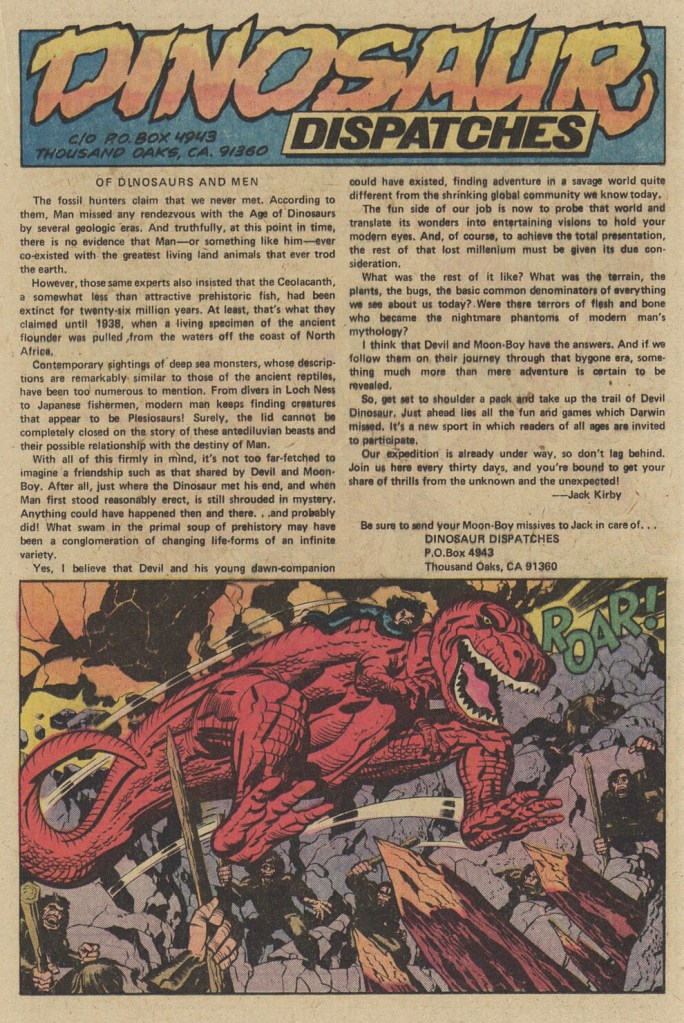
Kirby also provided copy for a text page introducing the series and setting out some of his goals with the book. I really love whenever Jack wound do this (his text feature in the first issue of DC’s OMAC is an absolute masterpiece, one that I and my circle of friends would occasionally read aloud for full effect.) There’s a directness and an earnestness to what he has to say that, when translated through his particular manner of speech (and his writing voice) was quite engaging.
 The Tom Brevoort Experience
I wasn’t averse to non-superhero stuff in that era but Kirby’s post-Fourth World work (Eternals and Kamandi excepted) left me baffled why he was considered some kind of genius (I hadn’t read much Silver Age Marvel back then). This book included. However it’s on the Marvel app so I’ll try it and see if it is indeed worth reassessing.
LikeLike
DEVIL DINOSAUR, like 2001, is one of Kirby’s books where it starts off a little thin, as if he’s not sure what to do with it so he’s just kind of reiterating the basic idea a few times. And then once he’s settled into it it gets very interesting. Once he gets to “Eev,” the book is really compelling.
Not that I thought so back when it was coming out, but like lots of others, I learned to set aside my “But it’s not like Englehart!” sense and react to it for what it is. And it makes me wish there was lots more of it.
LikeLiked by 1 person
Kirby was definitely marching to a different drum in this era, becoming more stylized and metaphorical (in both writing and art) at a time when most other comics were trying to be more gritty and true-to-life. It can’t have felt good for Kirby to see everyone else getting praised for doing riffs on his old characters, while he got pilloried for doing something new and different.
LikeLiked by 1 person
I only liked the non-super-hero Kirby of the time. I never bought an issue of Black Panther or Captain America. Devil Dinosaur, Eternals, Kamandi, machine Man, and Omac were my thing. Didn’t even like New Gods once I found it. TBH, I didn’t appreciate Kirby hero books until seeing F4 reprints. Still didn’t like the post-DC hero work but I was a convert to Kirby as being foundational to modern comics.
LikeLiked by 1 person
I was 13 when this came out and had been collecting 60’s Marvels for a while and a big Kirby and Ditko fan. I was heavy into the current Marvel books and it was clear that the stuff that Kirby and Ditko produced in the 70’s ran counter a lot of it. But not all of it…I think Devil Dinosaur, Machine Man, Shogun Warriors, and Godzilla might have overlapping audiences that were 13 or younger.
I think Kirby’s 70’s output has aged pretty well even if it seemed anachronistic at the time.
Out of step and kind of ugly? Sure! but it always looked like comics and generally entertaining.
LikeLiked by 1 person
I got this issue a few years after it hit the sinner racks. It came in a “Comic Book Collecting Kit” that had some wonderful starter comics in it. I had already been collecting for about four years by that time, but it was a wonderful X-Mas present!
LikeLiked by 1 person
Years after this series had ended and Marvel wanted to use the characters in the here and now, I wished they would have revealed it was always in the present in a hidden side valley next to the Savage Land ( but cut off from it ). Any Godzilla time travelling could be explained by Immortus shunting Godzilla out of the time stream into that present day hidden valley.
LikeLike
Devil Dinosaur wasn’t Jack Kirby’s first Marvel red T-Rex, see Amazing Adventures vol.1#3 ( August 1961 ) first story — “We Were Trapped In The Twilight World!” – page 9.
LikeLike